
Screenshots
 1 / 2
1 / 2The Story
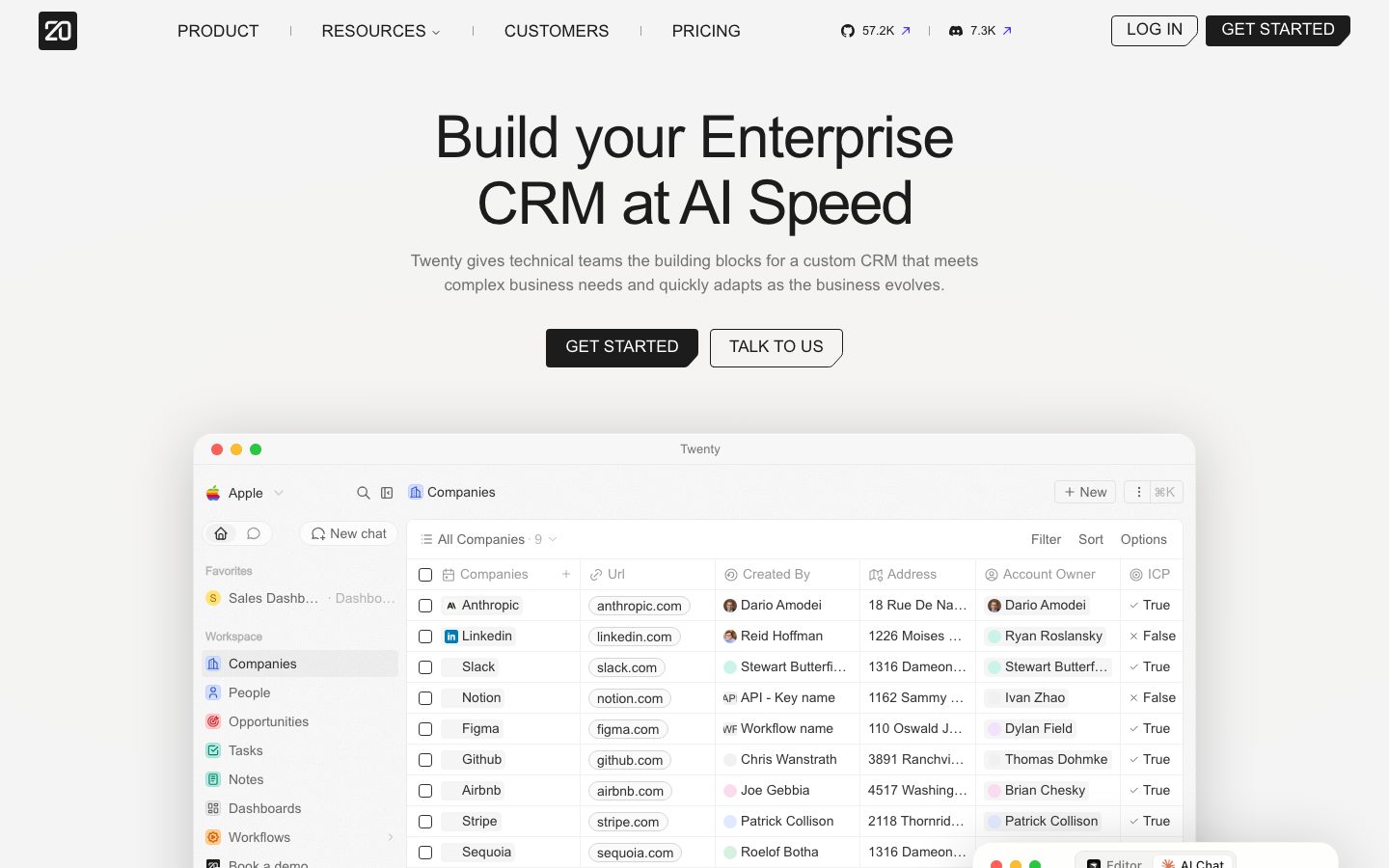
Twenty is a customer relationship management tool built as an open-source alternative to established CRM platforms. Its distinguishing design decision is that the data model is editable: a team defines its own objects, fields, and relationships rather than adapting to a fixed schema.
A CRM's value comes from the shape of its records, and most platforms fix that shape. Twenty exposes it. Companies, people, and opportunities are the defaults, but a team can add objects, add fields to existing objects, and define relations between them. Views and filters are built on top of whatever model the team creates.
The product is published as open source and can be self-hosted. The hosted service is the commercial layer. For teams whose CRM requirements do not match a standard sales pipeline, the editable model is the reason to consider it.
Overview
Twenty's premise is that a CRM's fixed schema is the constraint worth removing.
Companies, people, and opportunities ship as defaults. Unlike a conventional CRM, those objects are not closed: a team can add fields, add entirely new objects, and define relations between them.
Views are built on whatever model exists. A board, table, or filtered list reads from the team's objects, so a workflow that does not match a standard sales pipeline can still be represented.
The source is published and self-hosting is supported. A team that needs its customer data on its own infrastructure can run the product itself, with the operational responsibility that implies.
Key Features
- Editable data model
Objects, fields, and relations are defined by the team rather than fixed by the vendor.
- Custom views
Tables, boards, and filters are built on the team's own objects.
- Self-hostable
The product can run on your own infrastructure from the published source.
- Open-source core
The source is published in a public repository with a license file.
Where Twenty is a strong choice, and where it is not
Choose Twenty if your sales or customer process does not fit a standard pipeline and you would rather define the model than work around a fixed one.
Look elsewhere if you need a mature integration marketplace, or if you want a fully managed CRM with no operational surface.
Getting started
An instance is available quickly; modelling your pipeline is the work.
- ~15 minTime to first record
Create an account and the default objects — companies, people, opportunities — are ready to use.
- FreeCost to start
The cloud free tier covers small teams. Self-hosting is free.
- Docker for self-hostPrerequisites
Nothing for the hosted version. Self-hosting needs Docker and Postgres.
Known limitations
Constraints confirmed from the project's documentation.
- Younger than the established CRMs. Fewer integrations and fewer years of edge-case handling for a team depending on it daily.
- Smaller integration marketplace. A workflow built on a specific CRM integration may not have an equivalent yet.
- Self-hosting is your responsibility. Backups, upgrades, and the database are yours.
- Reporting is more limited than a mature CRM or a dedicated BI tool.
Pick Twenty if you want a CRM you can shape and host
It is built as a modern, extensible CRM rather than a configured SaaS product, which suits teams whose sales process does not fit a template.
The appeal is that the data model is yours to change and the product can run on your own infrastructure.
If your team needs a large integration marketplace and a long track record, a mature hosted CRM is the lower-risk choice.
FAQ
What is Twenty?
Twenty is an open-source CRM whose data model - objects, fields, and relations - can be edited by the team using it.
Is Twenty open source?
Yes. The source is published in a public repository with a license file. Check the repository for current license terms.
Can I self-host Twenty?
Yes. Self-hosting is supported, and the operator becomes responsible for upgrades, backups, and security.
Is Twenty free?
Twenty lists a free tier alongside paid plans. Check the pricing page for current limits.
What stack is Twenty built with?
CompassPad records Twenty as a TypeScript and React front end with a Node.js service layer and PostgreSQL storage, based on the public repository.
What we checked
- LIVESite and primary link
The marketing site resolved and the primary product link reached the product itself.
- PRICINGPricing page
The pricing page resolved and lists the current plans and limits.
- DOCSDocumentation
Public documentation resolved and covers the product's core surfaces.
- SOURCESource page
The linked source page resolved and is reachable without an account.
Discussion
No comments yet. Be the first.
Join the conversation. Sign up to comment.
Sign up free