Screenshots
 1 / 2
1 / 2The Story
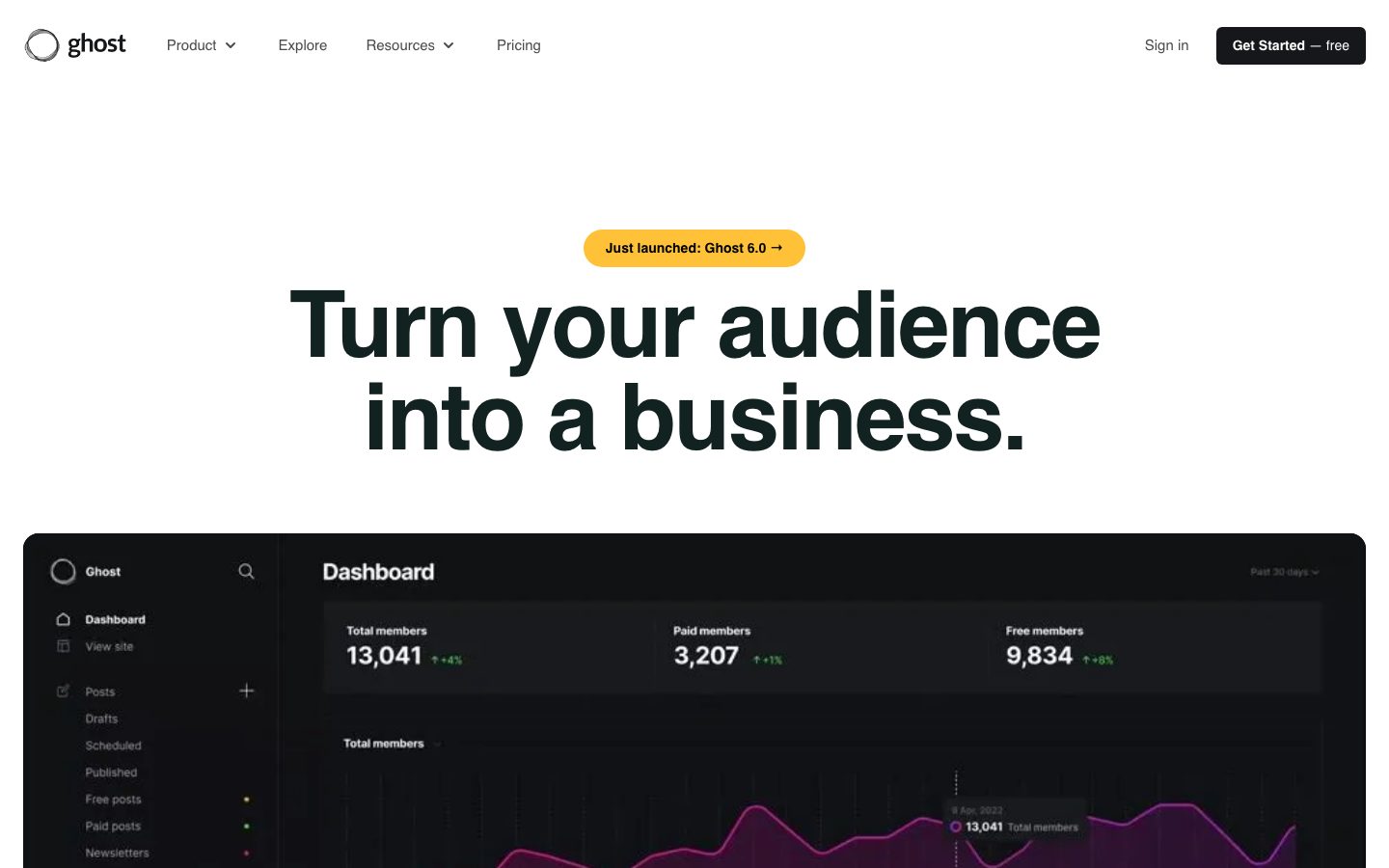
Ghost is a publishing platform that combines a website, a newsletter, and paid membership in one system. A publication runs on Ghost, posts are delivered by email to subscribers, and paid tiers are managed through the same admin rather than through a separate membership plugin.
The product is open source and can be self-hosted, and the hosted service is the commercial offering. Subscriptions are handled through Stripe, with the platform managing member records, tiers, and gated content. Because the site and the newsletter are the same system, a post does not have to be maintained in two places.
The tradeoff compared with a hosted newsletter service is that Ghost expects the publication to be a website first. It is a good fit for a writer or a small media business that wants a domain, an archive, and a subscriber list under its own control; it is a heavier tool for someone whose only need is to send an email to a list.
Overview
Ghost's design assumes a publication is a website and a newsletter at once, so it does not split them across two tools.
A post is written once and published to the site, delivered by email to subscribers, and gated according to the tier that can read it. Because those are one system rather than a website with a newsletter plugin, there is no second copy of the content to keep in sync and no separate subscriber list to reconcile.
Membership is built in. Tiers are defined in the admin, Stripe handles payment, and the platform tracks who is entitled to what. Free and paid subscribers can receive different content, and a post can be partially gated so the opening is public and the rest is for members.
The platform is open source and can be self-hosted, with the hosted service as the commercial option. Compared with a hosted newsletter service, Ghost expects the publication to be a website first, which makes it a heavier choice for someone whose only requirement is sending email to a list.
Key Features
- Site and newsletter in one
A post publishes to the website and sends by email from the same system, so content is not duplicated across tools.
- Paid membership tiers
Tiers are defined in the admin and enforced by the platform, with Stripe handling payment.
- Partial content gating
A post can be public up to a point and members-only after it, which supports a metered reading model.
- Self-hostable
The platform is open source and can run on your own infrastructure, keeping the subscriber list under your control.
Where Ghost is a strong choice, and where it is not
Choose Ghost when the publication is a website with an archive and a subscriber list, and paid membership should be part of the same system rather than a plugin.
Look elsewhere if the only requirement is sending email to a list, or if the publishing workflow needs deep customisation beyond themes and integrations. A dedicated newsletter service or a general CMS is the better shape in those cases.
Getting started
A publication is live quickly; the design and membership setup is the work.
- ~30 minTime to first post
Install a theme, write, and publish. The newsletter sends from the same editor.
- FreeCost to start
Self-hosted is free. Hosted plans are priced by member count and team size.
- Node for self-hostPrerequisites
Nothing for the hosted version. Self-hosting needs Node.js and MySQL.
Known limitations
Constraints confirmed from the project's documentation.
- Self-hosting is your responsibility. The database, upgrades, and email deliverability are yours to manage.
- Design is theme-bound. Customisation happens through themes, not a visual builder.
- Email deliverability depends on your setup. A self-hosted instance still needs a sending configuration that inboxes accept.
- Membership requires Stripe. Paid subscriptions are processed through Stripe, so that account is required.
Pick Ghost when the publication should be a site and a newsletter at once
The website, the email, and the paywall are one system, so a post is not maintained in two places.
The differentiator is that membership is built in rather than added by a plugin, and the content is not duplicated between a site and a mailing list.
If the only requirement is sending email to a list, a dedicated newsletter service is a lighter tool.
FAQ
What is Ghost?
Ghost is an open-source publishing platform that combines a website, newsletter delivery, and paid membership in one system.
Is Ghost free?
The software is open source and free to self-host. Hosted plans are priced by member count and team size.
Can Ghost send newsletters?
Yes. A post publishes to the site and sends by email to subscribers from the same system.
Does Ghost support paid subscriptions?
Yes. Membership tiers are defined in the admin, enforced by the platform, and paid through Stripe.
What stack is Ghost built with?
CompassPad records Ghost as a Node.js application with MySQL, based on its public repository.
What we checked
- LIVESite and primary link
The marketing site resolved and the primary product link reached the application.
- PRICINGPricing page
The pricing page resolved and lists a free self-hosted option alongside paid hosted plans.
- DOCSDocumentation
Documentation is public and covers publishing, memberships, gating, and installation.
- FRESHNESSChangelog
A dated public changelog is published and reachable without an account.
Discussion
No comments yet. Be the first.
Join the conversation. Sign up to comment.
Sign up free