

Screenshots
The Story
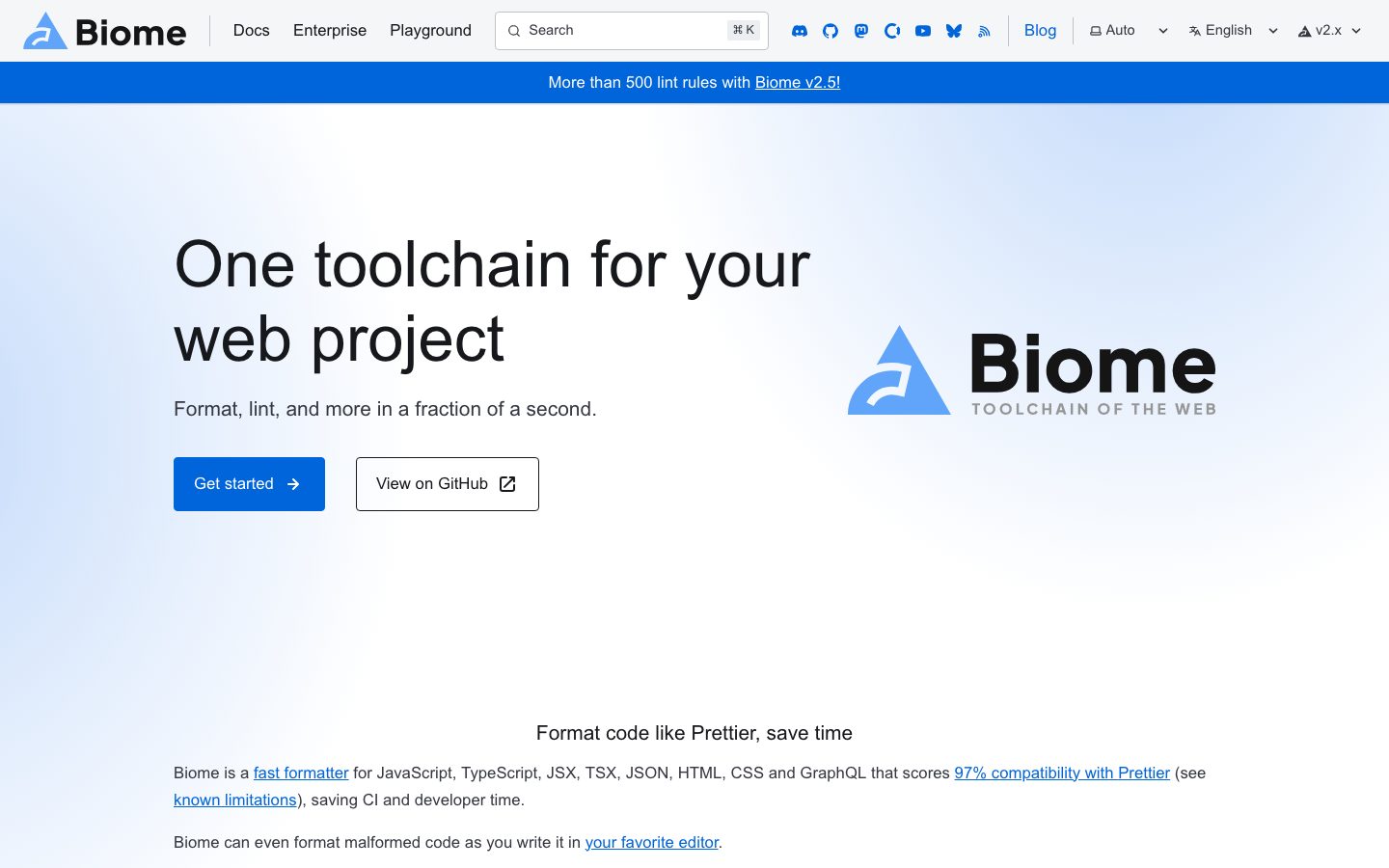
Biome is a toolchain that replaces a formatter and a linter with a single Rust binary. It formats JavaScript, TypeScript, JSX, JSON, and CSS, and it lints the same file set, so a project configures one tool and runs one command instead of coordinating several.
The project began as a fork of Rome Tools after that project was discontinued, and it inherited the goal of unifying the tools that a JavaScript project normally assembles from separate packages. Because the implementation is compiled, checks run without the startup cost that accumulates when several Node-based tools each parse the project separately.
Diagnostics are designed to be actionable: a lint error points at the rule, explains the problem in prose, and in many cases offers a safe fix that can be applied automatically. The main limitation is breadth. Biome's rule set does not yet cover everything a mature ESLint configuration with type-aware rules can express, so projects with heavy custom lint requirements sometimes run both.
Overview
Biome's premise is that formatting and linting the same files should not require several tools that each parse the project.
The tool formats JavaScript, TypeScript, JSX, JSON, and CSS, and lints the same set. A project configures one file and runs one command, which removes the version coordination that comes with assembling a formatter, a linter, and their plugins from separate packages.
Because the implementation is compiled Rust, the tool does not pay the per-process startup cost that Node-based tools pay. On large repositories that difference is visible in editor responsiveness and in CI time, since each tool no longer re-parses the project independently.
Diagnostics aim at actionability. A lint error names the rule, explains the problem, and often offers a safe fix that can be applied automatically, including from the editor. The tradeoff is rule coverage: Biome's set does not yet match everything a mature ESLint configuration with type-aware rules can express, so some projects run both tools and let Biome handle formatting.
Key Features
- Formatter and linter in one
A single binary handles formatting and linting for the same files, so there is one config and one command to run.
- Compiled for speed
The Rust implementation avoids per-process startup cost, which shows up in editor responsiveness and CI time on large repositories.
- Actionable diagnostics
Errors name the rule, explain the problem, and frequently offer a safe fix that can be applied automatically.
- First-class editor support
An official language server integrates with common editors so diagnostics and fixes appear while typing.
Where Biome is a strong choice, and where it is not
Choose Biome when the project wants formatting and linting from one fast tool with a single configuration file, and when the existing lint rules are mostly covered by its set.
Look elsewhere if the project depends on type-aware lint rules or specific ESLint plugins that Biome does not implement. In that case Biome can still handle formatting while ESLint keeps the rules that matter.
Getting started
Replacing a formatter and linter takes minutes; matching an existing rule set takes longer.
- ~5 minTime to first check
Install the binary and run it. Formatting works with no configuration at all.
- FreeCost to start
Open source under the MIT license.
- Node or a binaryPrerequisites
A JavaScript or TypeScript project. A standalone binary is available.
Known limitations
Constraints confirmed from the project's documentation.
- Rule coverage is narrower than ESLint. Type-aware rules and many plugins are not implemented.
- Migrating an existing config takes work. Rules that do not exist in Biome need a decision: drop them or run both tools.
- Formatting differences will reflow files. Adopting it on an existing codebase produces a large diff.
- Younger project. Fewer years of edge-case handling than the tools it replaces.
Pick Biome when you want one fast tool instead of several
A single compiled binary removes the coordination cost of a formatter, a linter, and their plugins.
The differentiator is speed and consolidation: one config, one command, and no per-process startup cost. On a large repository that is visible in both the editor and CI.
If your lint setup depends on type-aware rules, keep ESLint for those and let Biome handle formatting.
FAQ
What is Biome?
Biome is a Rust toolchain that formats and lints JavaScript, TypeScript, JSX, JSON, and CSS from a single binary.
Is Biome free?
Yes. Biome is open source under the MIT license, so there is no licence cost.
Does Biome replace ESLint and Prettier?
It can replace both for many projects. Rule coverage is narrower than a mature ESLint setup with type-aware rules, so some projects run both.
Which languages does Biome support?
JavaScript, TypeScript, JSX, JSON, and CSS are covered for formatting and linting, with more languages in progress.
What stack is Biome built with?
CompassPad records Biome as a Rust implementation with a TypeScript language server, based on its public repository.
What we checked
- LIVESite and primary link
The marketing site resolved and the primary product link reached the application.
- PRICINGPricing page
The toolchain is open source and free to use; there is no paid pricing page.
- DOCSDocumentation
Documentation is public and covers configuration, the rule set, and editor integration.
- FRESHNESSChangelog
A dated public blog publishes releases and is reachable without an account.
Discussion
No comments yet. Be the first.
Join the conversation. Sign up to comment.
Sign up free