Discourse
Screenshots
 1 / 2
1 / 2The Story
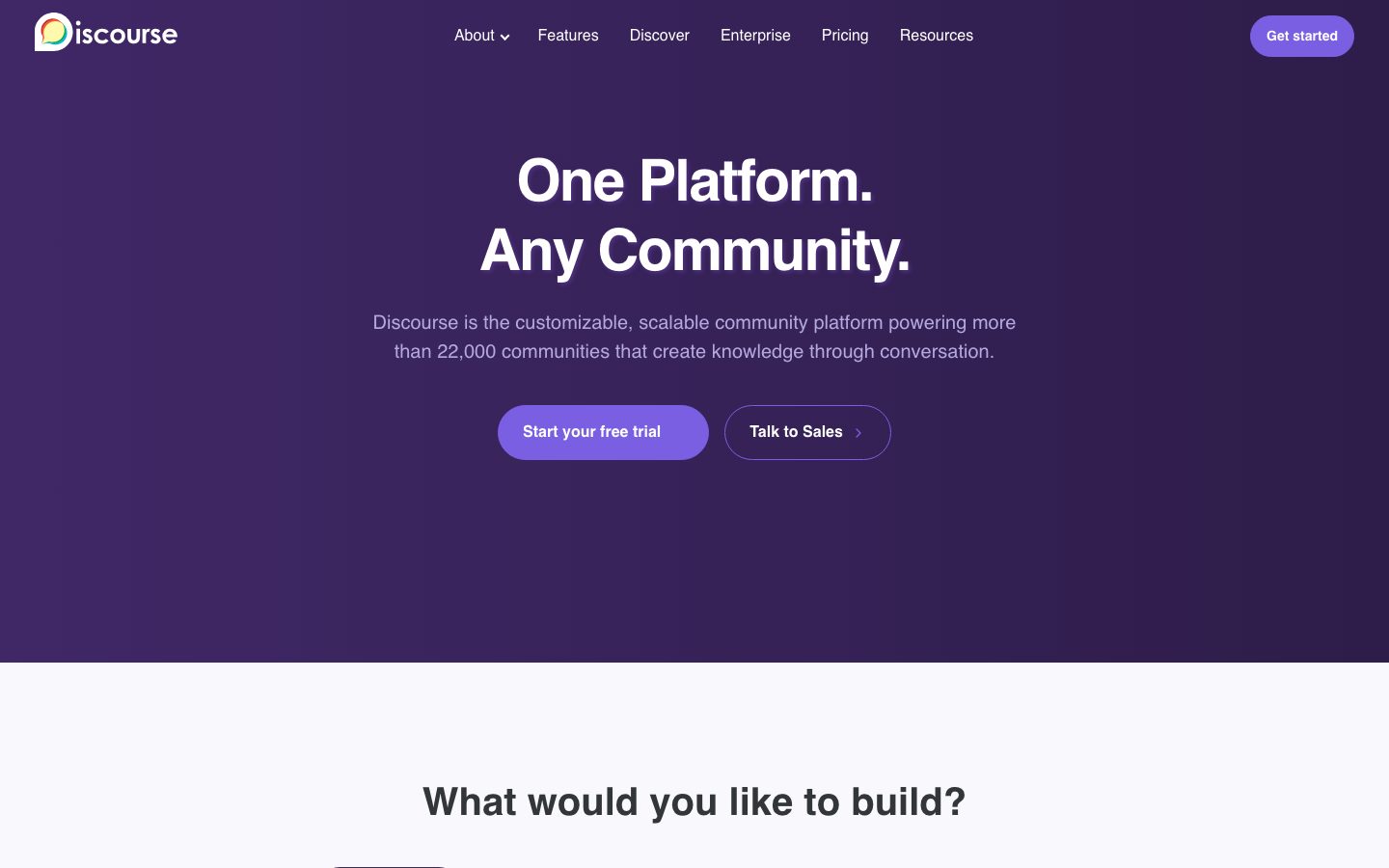
Discourse is forum software designed for threaded, long-form discussion. Unlike a chat product, a topic is a first-class object with a title, a category, and replies that can be read in order, which makes a community's history searchable and referenceable.
The platform adds the mechanics a community needs to stay healthy: trust levels that grant permissions as a member participates, flagging and moderation queues, and automated summaries. Topics can be categorised and tagged, and a topic can be marked as solved so the answer is visible without reading the thread.
Discourse is open source and can be self-hosted, with a hosted plan as the alternative. It is a good fit for a product community, a support forum, or a standards discussion where answers should be findable later. It is a poor fit for real-time conversation, which is what a chat product is for.
Overview
Discourse's design assumption is that a community's value is its accumulated answers, so topics are structured to be found rather than only read live.
A topic has a title, a category, and an ordered set of replies. That structure is what makes a forum different from a chat channel: a question asked a year ago is still addressable, and the accepted answer can be marked so a reader does not have to reconstruct it from the thread.
Community health is handled with mechanics rather than only moderation. Trust levels grant permissions as a member participates, which distributes some moderation work to people who have demonstrated they will use it well. Flagging opens a moderation queue, and automated summaries surface long threads.
The platform is open source and can be self-hosted, with a hosted plan as the alternative. It suits a product community, a support forum, or a standards discussion where answers should remain findable. Real-time conversation is a different problem and a chat product serves it better.
Key Features
- Topics and categories
Discussion is organised into titled topics within categories and tags, so history stays addressable.
- Trust levels
Permissions are granted as a member participates, which distributes some moderation work across the community.
- Solved topics
An answer can be marked as the solution, so a reader finds it without reconstructing the thread.
- Self-hostable
The platform is open source and can run on your own infrastructure, keeping the community's data under your control.
Where Discourse is a strong choice, and where it is not
Choose Discourse when a community needs long-form discussion whose answers remain findable, and moderation should scale with participation.
Look elsewhere if the need is real-time conversation or a simple comment section. A forum is a different shape from a chat product and a heavier one than embedded comments.
Getting started
The hosted version is live in minutes; self-hosting takes an afternoon.
- ~30 minTime to first topic
On the hosted plan, create a community and post. Categories work without configuration.
- FreeCost to start
Self-hosted is free. Hosted plans are priced by community size.
- Docker for self-hostPrerequisites
Nothing for hosted. Self-hosting needs Docker, Postgres, and Redis.
Known limitations
Constraints confirmed from the project's documentation.
- Self-hosting is a real commitment. The database, mail configuration, and upgrades are yours.
- Email deliverability matters. A self-hosted forum needs a sending setup that inboxes accept, or notifications fail.
- Not for real-time chat. It is a forum; live conversation is a different product.
- Requires seeding. A new forum with no topics stays empty; communities need an initial push.
Pick Discourse when answers should stay findable
Topics have titles and ordered replies, so a question asked a year ago is still addressable.
Trust levels distribute some moderation work as members participate, which is how a community scales without a large moderation team.
If the need is real-time conversation or a simple comment section, a forum is a heavier shape than required.
FAQ
What is Discourse?
Discourse is open-source forum software for long-form, threaded community discussion with moderation and trust-level mechanics.
Is Discourse free?
The software is open source and free to self-host. Hosted plans are priced by community size.
How is it different from chat?
Topics have titles and ordered replies, so discussion remains searchable and referenceable rather than scrolling away.
What are trust levels?
Permissions granted as a member participates, which lets experienced members take on some moderation work.
What stack is Discourse built with?
CompassPad records Discourse as a Ruby on Rails backend with PostgreSQL and an Ember frontend, based on its public repository.
What we checked
- LIVESite and primary link
The marketing site resolved and the primary product link reached the application.
- PRICINGPricing page
The pricing page resolved and lists a free self-hosted option alongside paid hosted plans.
- DOCSDocumentation
Documentation is public and covers installation, moderation, and administration.
- FRESHNESSChangelog
Dated releases are published on a public forum category and are reachable without an account.
Discussion
No comments yet. Be the first.
Join the conversation. Sign up to comment.
Sign up free