

Screenshots
The Story
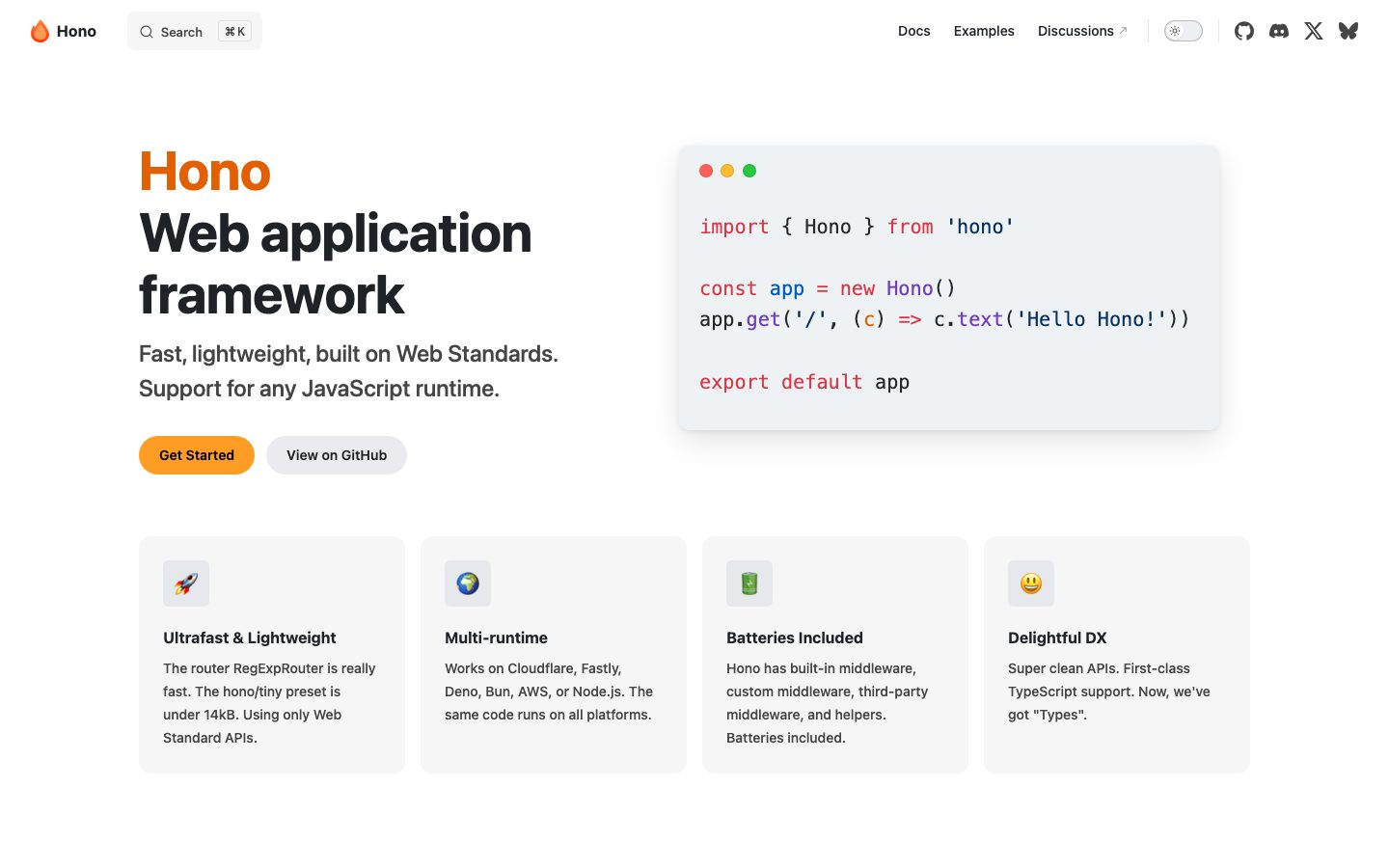
Hono is a web framework for JavaScript runtimes. The same application code runs on Cloudflare Workers, Deno, Bun, Node.js, and several other environments, because the framework targets the standard Request and Response interfaces rather than a runtime-specific API.
The core is deliberately small. Routing is built on a radix tree, middleware composes as a chain, and the framework adds typed helpers for the things an HTTP service needs: parsing input, validating it, setting headers, and returning JSON. Type inference carries path parameters and request bodies through to the handler, so a route can be typed without a separate schema layer.
Hono is a good fit for APIs, edge functions, and small services where a full application framework would be excess weight. It is not trying to be a batteries-included framework: there is no built-in ORM, no opinion about the frontend, and no plugin ecosystem of the size a larger framework has accumulated.
Overview
Hono's portability comes from a decision to depend on web-standard interfaces rather than runtime-specific APIs.
A Hono application is a router with handlers. Because the framework is built on the standard Request and Response objects, the same code runs unmodified on Cloudflare Workers, Deno, Bun, Node.js, and other environments that implement the standard. Moving a service between runtimes does not require rewriting the routing layer.
The core is small by design. Routing uses a radix tree, middleware composes as a chain, and helpers cover the common HTTP tasks: reading and validating input, setting headers, and returning JSON. Type inference carries path parameters and parsed bodies into the handler, so a route can be typed without introducing a separate schema layer.
That restraint is the tradeoff. There is no bundled ORM, no opinion about the frontend, and no plugin ecosystem the size of a full application framework. Teams adopting Hono generally already have a data layer and want the HTTP layer to stay out of the way.
Key Features
- Runtime portability
The framework targets standard Request and Response, so the same application runs on Workers, Deno, Bun, and Node.js.
- Typed routing
Path parameters and parsed request bodies are inferred into the handler, so routes can be typed without a separate schema layer.
- Composable middleware
Middleware composes as a chain, and the framework ships common pieces for auth, CORS, logging, and compression.
- Small footprint
The core is deliberately minimal, which keeps cold starts short on edge runtimes.
Where Hono is a strong choice, and where it is not
Choose Hono for APIs, edge functions, and small services where portability across runtimes matters and a full application framework would be excess weight.
Look elsewhere if the project expects a batteries-included framework with a bundled ORM, an admin layer, or a large first-party plugin ecosystem. Hono deliberately stops at the HTTP layer.
Getting started
A route responds within minutes; the portability claim holds across runtimes.
- ~10 minTime to first route
Install, define a route, and it runs. Middleware is added as needed.
- FreeCost to start
Open source under the MIT license.
- A JS runtimePrerequisites
Node.js, Bun, Deno, or a Workers environment.
Known limitations
Constraints confirmed from the framework's documentation.
- Deliberately minimal. No ORM, no admin layer, and no opinion about the frontend.
- Smaller ecosystem. Fewer first-party plugins than a full application framework.
- Portability has limits. Runtime-specific bindings still need per-runtime code.
- Not for a large application on its own. A bigger project will assemble its own structure around it.
Pick Hono when the HTTP layer should stay small and portable
The same application runs on Workers, Deno, Bun, and Node.js because it targets the standard request interfaces.
The differentiator is portability without a rewrite. Moving a service between runtimes is a deployment change rather than a code change.
If you want a batteries-included framework with a bundled data layer, Hono deliberately stops short of that.
FAQ
What is Hono?
Hono is a small web framework for JavaScript runtimes that targets standard Request and Response, so the same code runs on many platforms.
Is Hono free?
Yes. Hono is open source under the MIT license, so there is no licence cost.
Which runtimes does Hono support?
Cloudflare Workers, Deno, Bun, Node.js, and other environments that implement the standard web request interfaces.
Does Hono include an ORM?
No. The framework stays at the HTTP layer and leaves the data layer to the application.
What stack is Hono built with?
CompassPad records Hono as a TypeScript library with no runtime dependencies, based on its public repository.
What we checked
- LIVESite and primary link
The marketing site resolved and the primary product link reached the application.
- PRICINGPricing page
The framework is open source and free to use; there is no paid pricing page.
- DOCSDocumentation
Documentation is public and covers routing, middleware, and runtime-specific setup.
- FRESHNESSChangelog
Dated releases are published on the public repository and are reachable without an account.
Discussion
No comments yet. Be the first.
Join the conversation. Sign up to comment.
Sign up free