

Screenshots
 1 / 2
1 / 2The Story
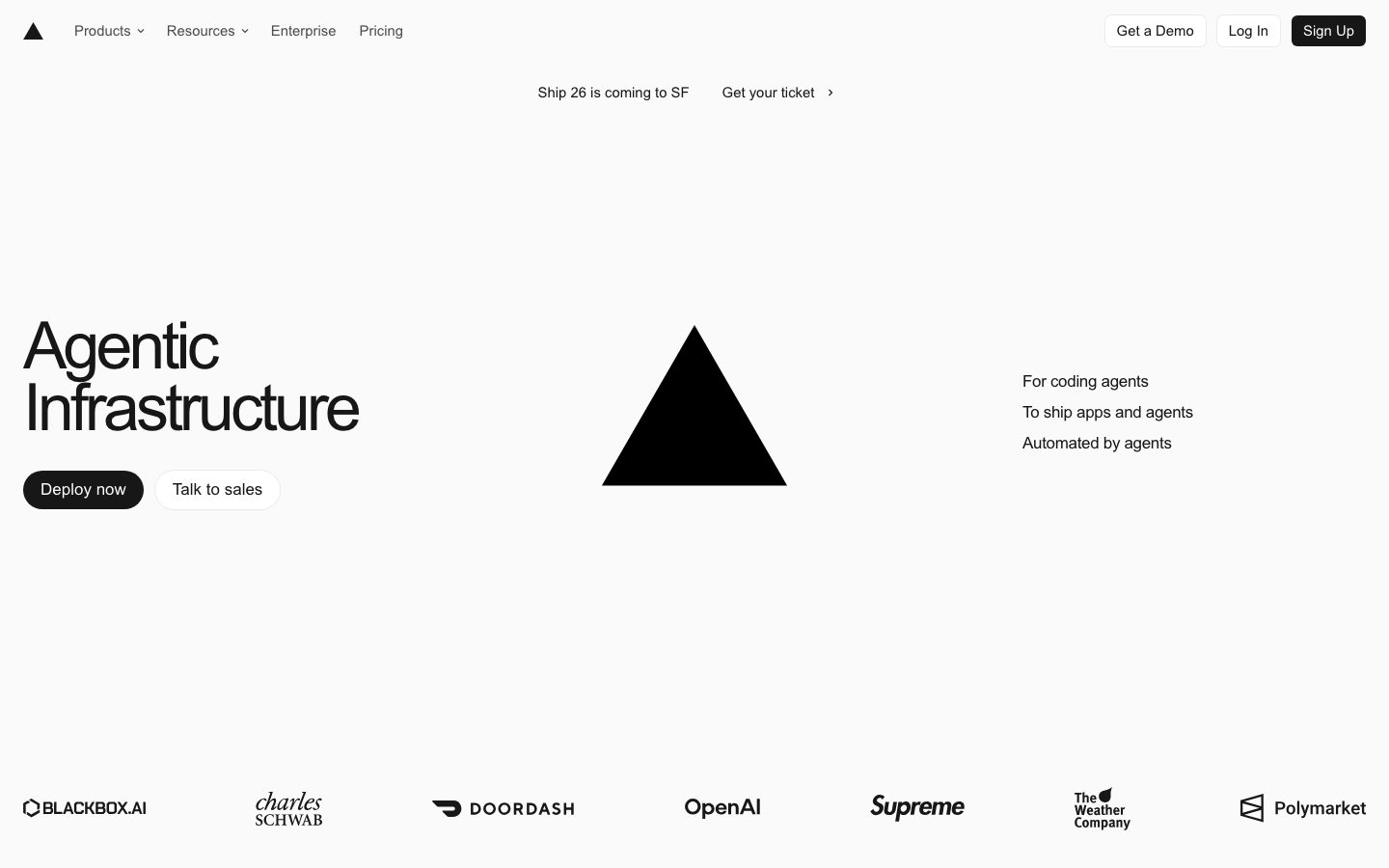
Vercel is a hosting platform built around the frontend workflow. A project connects to a Git repository, and every push produces a deployment: production builds from the main branch, and preview builds from every other branch and pull request.
The platform is best known for Next.js, the React framework its parent company maintains, but it builds and serves other frameworks and static output too. Deployments run on a global edge network, and build configuration lives in a checked-in file rather than only in a dashboard, so settings travel with the code.
Beyond hosting, Vercel sells the surrounding primitives: serverless and edge functions, image optimization, and storage through marketplace partners. Teams that want one vendor for the frontend path consolidate here; teams with long-running backend workloads usually keep those elsewhere.
Overview
Vercel's core abstraction is the deployment: an immutable build of one commit, addressable by its own URL.
Connect a repository and the platform takes over the build. Each push produces a deployment; the branch configured as production promotes to the main domain, while every other branch gets a preview URL that stays reachable for the life of the branch. Pull requests show the preview link inline, which makes reviewing a visual change practical without maintaining a staging environment.
Build configuration lives in a versioned file in the repository, so settings are reviewable in the same diff as the code that needs them. Environment variables are scoped per environment rather than per project, which keeps preview builds from reaching production data by accident.
The runtime layer adds serverless and edge functions, image optimization, and incremental static regeneration for framework output that supports it. Databases and storage are sold through marketplace integrations rather than as first-party products, so the data layer stays a separate vendor decision.
Key Features
- Preview deployments per branch
Every branch and pull request gets its own reachable URL, so a reviewer opens the change without a shared staging environment.
- Git-based configuration
Build settings and routing rules live in checked-in files, so they are reviewed and versioned alongside the application code.
- Edge and serverless functions
Request handlers run close to the visitor, with a runtime that supports streaming responses and framework server rendering.
- Instant rollback
Previous deployments stay addressable, so promoting an earlier build back to production is a pointer change rather than a rebuild.
Where Vercel is a strong choice, and where it is not
Choose Vercel when the product is a frontend or a framework-rendered site and the team wants deployment to disappear behind a Git push. The preview workflow is the strongest reason: it removes the staging-environment tax from review.
Look elsewhere if the workload is a long-running process, a queue worker, or anything needing a persistent connection model the serverless runtime does not fit. Teams with heavy backend services usually host those separately and use Vercel only for the frontend tier.
Getting started
A repository deploys on the first try; the work is understanding what the runtime will not do.
- ~5 minTime to first deploy
Connect a repository and the framework is detected, built, and deployed with a preview URL.
- FreeCost to start
The free tier covers personal projects. Paid plans add seats, build minutes, and higher limits.
- A repoPrerequisites
A Git repository. No infrastructure configuration is required.
Known limitations
Constraints confirmed from the platform's documentation.
- Serverless functions are not for long-running work. A queue worker or a persistent connection does not fit the runtime model.
- Usage costs can surprise. Bandwidth, invocations, and build minutes are metered, and a viral page shows up on the bill.
- Storage is a separate vendor. Databases and object storage come through marketplace integrations rather than the platform.
- Preview deployments can reach production data if environment variables are not scoped carefully.
Pick Vercel when the frontend is the product
The preview-deployment workflow is the reason to choose it: every branch gets a real URL, which removes the staging-environment tax from review.
The product's bet is that deployment should disappear behind a Git push. For a frontend or a framework-rendered site, that is exactly what happens.
If the workload is a long-running backend service, host it elsewhere and use this for the frontend tier only.
FAQ
What is Vercel?
Vercel is a hosting platform for frontend and framework-rendered projects that turns a Git push into a deployment with its own URL.
Is Vercel free?
Vercel lists a free tier for personal projects alongside paid plans that add team seats, more build minutes, and higher usage limits.
What is a preview deployment?
A preview deployment is an immutable build of a non-production branch, reachable at its own URL and linked from the pull request.
Can I roll back a bad release?
Yes. Previous deployments remain addressable, so an earlier build can be promoted back to production without rebuilding.
What stack is Vercel built with?
CompassPad records Vercel as a Next.js and TypeScript platform with a Node.js service layer, based on public engineering writing and job listings.
What we checked
- LIVESite and primary link
The marketing site resolved and the primary product link reached the application.
- PRICINGPricing page
The pricing page resolved and lists a free tier alongside paid plans that add seats, build minutes, and higher usage limits.
- DOCSDocumentation
Product documentation is public and covers deployments, functions, and project configuration.
- FRESHNESSChangelog
A dated public changelog is published and reachable without an account.
Discussion
No comments yet. Be the first.
Join the conversation. Sign up to comment.
Sign up free