

Screenshots
 1 / 2
1 / 2The Story
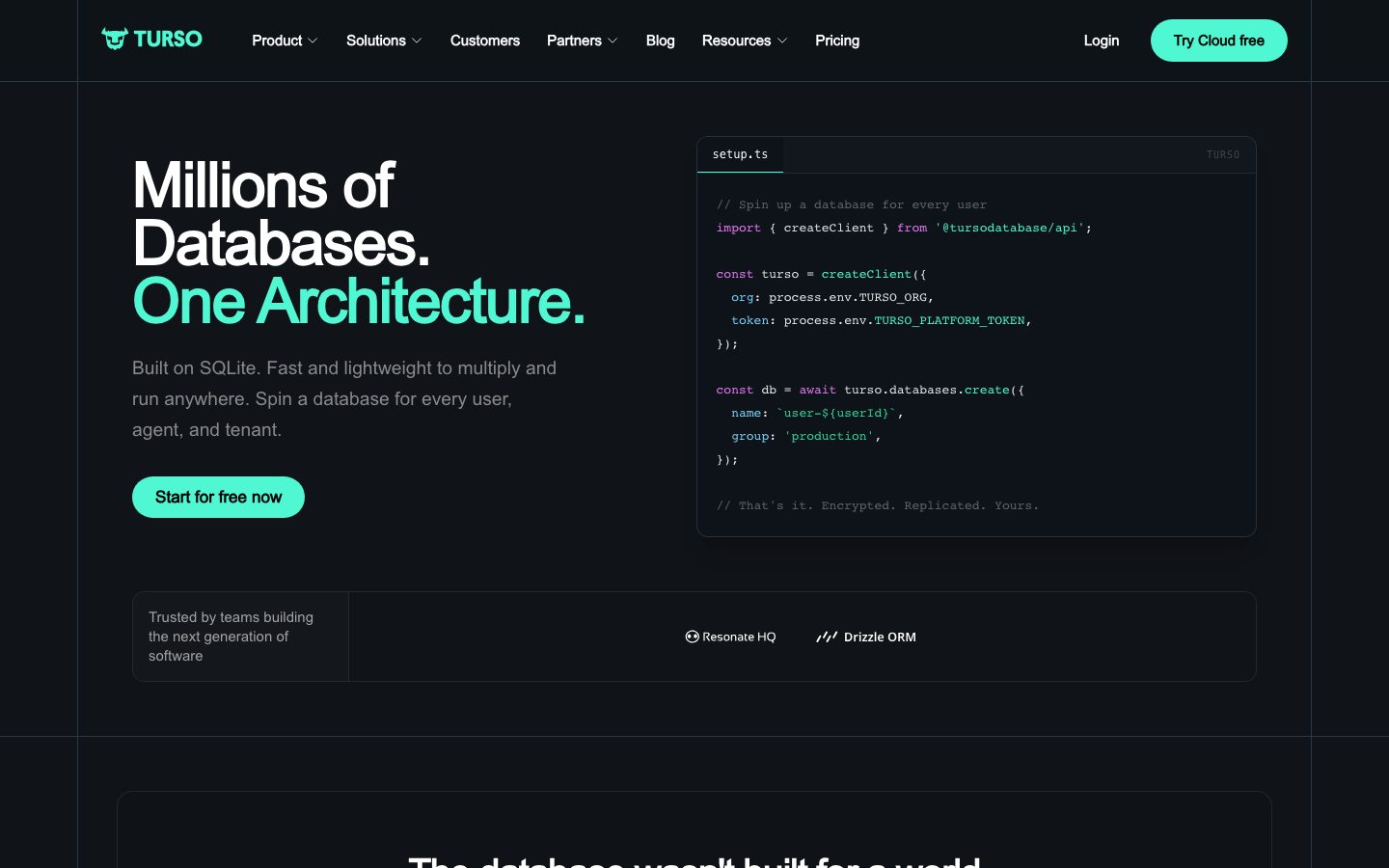
Turso is a managed SQLite service built on libSQL, an open-source fork of SQLite that adds replication and network access. Each database is a SQLite file, which means the operational model is a file rather than a cluster: small, fast to copy, and trivial to isolate per tenant.
Databases can be placed in multiple regions, with one primary accepting writes and read replicas serving queries locally. The embedded replica mode goes further, keeping a local copy inside the application process so reads avoid a network round trip entirely and sync in the background.
The appeal is cost and simplicity at high database counts. A multi-tenant product can give every customer their own database without running a fleet of Postgres instances. The constraint is that SQLite is a single-writer system, so write-heavy workloads need the primary and do not benefit from the replica topology.
Overview
Turso takes SQLite, adds replication and a network protocol, and sells the result as a managed service.
Every Turso database is a SQLite file. That is the whole design premise, and it drives the rest: files are small, copying one is cheap, and isolating a tenant means creating another file rather than provisioning another cluster. Products with thousands of small customers fit this shape far better than a shared Postgres instance with row-level tenancy.
Replication works in two modes. In the hosted mode, one primary region accepts writes and read replicas in other regions serve queries from local storage. In embedded replica mode, the application keeps a local copy of the database inside its own process, reads from it directly, and syncs with the primary in the background. Reads then cost no network round trip at all.
The constraint is inherited from SQLite: writes serialize through a single primary. Read-heavy and per-tenant workloads benefit enormously; a single hot table taking sustained writes does not, and the replica topology will not help because every write still lands on the primary.
Key Features
- Database per tenant
Because each database is a SQLite file, giving a customer their own database is cheap and provides hard isolation without shared-schema tenancy.
- Embedded replicas
The application holds a local copy of the database and reads from it directly, syncing with the primary in the background.
- Regional read replicas
Read replicas in additional regions serve queries from local storage while a single primary accepts writes.
- libSQL compatibility
The engine is an open-source SQLite fork, so existing SQLite tooling and SQL semantics carry over.
Where Turso is a strong choice, and where it is not
Choose Turso when the product is read-heavy, multi-tenant, or needs a database close to users without operating a distributed SQL cluster. The per-tenant file model is the strongest reason.
Look elsewhere if a single table takes sustained high write volume, or if the application depends on Postgres-specific features such as extensions, rich types, or a mature row-level security model. SQLite's single-writer behaviour is a real ceiling.
Getting started
A database is available in seconds; the value appears at high tenant counts.
- ~2 minTime to first query
Create a database and a connection string is ready. It is a SQLite file behind the scenes.
- FreeCost to start
The free tier covers a small database. Paid plans are usage-based.
- NothingPrerequisites
An account. Any SQLite-compatible client works.
Known limitations
Constraints confirmed from the platform's documentation.
- SQLite is single-writer. Write-heavy workloads serialize through the primary and do not benefit from replicas.
- Fewer features than Postgres. Extensions, rich types, and mature row-level security are not available.
- Embedded replicas add sync complexity. The application holds a local copy, and conflict handling is your concern.
- Replica lag is possible. A read immediately after a write may not see it depending on the replica.
Pick Turso when you need a database per tenant
Because each database is a SQLite file, giving a customer their own database is cheap and provides hard isolation.
The differentiator is cost and simplicity at high database counts, which a shared Postgres instance does not match.
If a single table takes sustained high write volume, or you depend on Postgres-specific features, this is the wrong engine.
FAQ
What is Turso?
Turso is a managed SQLite service built on libSQL that replicates databases to multiple regions and supports local embedded replicas.
Is Turso free?
Turso lists a free tier alongside usage-based paid plans. Check the pricing page for current database and storage allowances.
What is an embedded replica?
An embedded replica is a local copy of the database held inside the application process, so reads avoid a network round trip and sync in the background.
Can Turso handle many tenants?
Yes. Because each database is a SQLite file, creating a separate database per tenant is inexpensive and provides hard isolation.
What stack is Turso built with?
CompassPad records Turso as a Rust database engine with a TypeScript and Go control plane, based on public repository and job listing evidence.
What we checked
- LIVESite and primary link
The marketing site resolved and the primary product link reached the application.
- PRICINGPricing page
The pricing page resolved and lists a free tier alongside usage-based paid plans.
- DOCSDocumentation
Product documentation is public and covers replication, embedded replicas, and the libSQL engine.
- FRESHNESSChangelog
A dated public blog is published and reachable without an account.
Discussion
No comments yet. Be the first.
Join the conversation. Sign up to comment.
Sign up free