
 Featured
Supabase
Screenshots
 1 / 2
1 / 2The Story
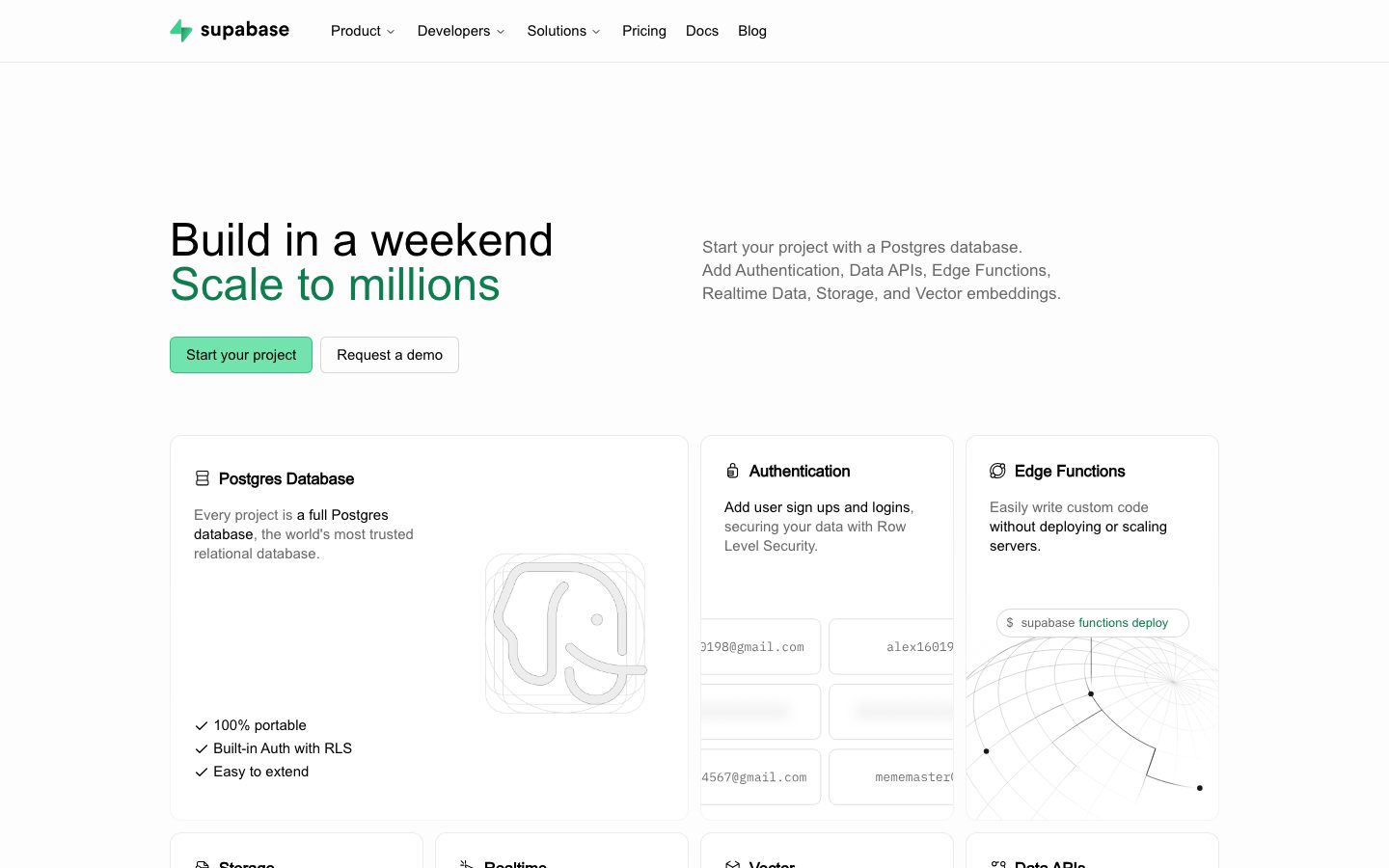
Supabase is a backend platform built on PostgreSQL. It packages the pieces most applications need at the start - a database, authentication, file storage, and realtime subscriptions - behind one dashboard and one set of client libraries.
The database is the center of the product, not a hidden implementation detail. Tables are ordinary Postgres tables, row-level security policies are ordinary Postgres policies, and the dashboard exposes the SQL. A team can connect with any Postgres client, run migrations with any migration tool, and leave with its data intact.
Around the database, Supabase adds services that would otherwise be separate vendors: authentication with social providers and row-level-security-aware sessions, object storage with access policies, edge functions for server-side code, and realtime channels for broadcasting row changes to connected clients. The open-source core is published in a public repository, and the hosted service and self-hosted deployment are documented side by side.
Overview
Supabase's distinguishing choice is that the database underneath is not abstracted away.
Every project is a PostgreSQL database. The table editor writes ordinary tables, row-level security is configured with ordinary policies, and the SQL editor runs ordinary queries. A team can point any Postgres client at the connection string and work with the same data the client libraries see.
The bundled services cover the common gaps. Authentication issues sessions that row-level-security policies can read, so authorization lives in the database rather than in application middleware. Storage exposes files through the same policy system. Realtime subscribes clients to row changes over a websocket.
Edge functions run server-side code close to the user when a client-side query is not appropriate. The open-source repository publishes the core, and the self-hosting documentation covers running the stack on your own infrastructure - with the usual caveat that operating it becomes your responsibility.
Key Features
- Plain Postgres underneath
Tables, policies, and queries are standard PostgreSQL, so the data is portable and the skills transfer.
- Auth tied to row-level security
Sessions carry a role the database can read, so authorization is enforced in policies rather than in application code alone.
- Realtime subscriptions
Clients subscribe to row changes over a websocket instead of polling an endpoint.
- Open-source core
The core is published in a public repository, and self-hosting is documented as a first-class path.
Where Supabase is a strong choice, and where it is not
Choose Supabase if you want a managed backend whose foundation is a database you already understand, and you would rather write SQL and policies than learn a proprietary data model.
Look elsewhere if you need a fully managed service with no operational surface at all, or if your workload is a poor fit for a single relational database.
Getting started
A project can be running with a real database in under ten minutes, which is the point of the product.
- ~10 minTime to first query
Create a project, wait for provisioning, and query from the dashboard or a client library.
- FreeCost to start
The free tier includes two active projects. Paid plans add compute, storage, and daily backups.
- NothingPrerequisites
An account. No credit card for the free tier, no infrastructure to provision.
Known limitations
Confirmed constraints from the public documentation and pricing page.
- Free projects pause when idle. A paused project needs a manual resume, which makes the free tier unsuitable for anything user-facing.
- Vendor-specific extensions. Realtime, auth, and storage are Supabase products rather than portable Postgres features, so migrating away means replacing them.
- No self-hosting on the free tier. The open-source stack exists, but running it is your operational problem.
- Row-level security is required, not optional. Exposing the database to a client without correct policies is a data leak, and the defaults assume you will write them.
Pick Supabase when you want Postgres plus the surrounding services
It is the fastest path from an empty repository to an application with auth, a database, and file storage, as long as you accept the platform's opinions.
The value is consolidation: one vendor for the database, authentication, storage, and realtime subscriptions, with a client library that reaches all of them. That removes several integration decisions from a new project.
The cost is coupling. The further you use the platform-specific features, the more work a migration becomes. Teams that expect to move to their own infrastructure later should keep the portable parts portable.
FAQ
What is Supabase?
Supabase is an open-source backend platform built on PostgreSQL that bundles authentication, storage, edge functions, and realtime subscriptions.
Is Supabase open source?
Yes. The core is published in a public repository with a license file. Check the repository for current license terms.
Can I self-host Supabase?
Yes. Self-hosting is documented as a first-class path, and the operator becomes responsible for upgrades, backups, and security.
Is Supabase free?
Supabase lists a free tier alongside usage-based paid plans. Check the pricing page for current limits.
What database does Supabase use?
Supabase runs PostgreSQL. Tables, policies, and queries are standard Postgres rather than a proprietary layer.
What we checked
- LIVESite and primary link
The marketing site resolved and the primary product link reached the product itself.
- PRICINGPricing page
The pricing page resolved and lists the current plans and limits.
- DOCSDocumentation
Public documentation resolved and covers the product's core surfaces.
- CHANGELOGChangelog page
The linked changelog page resolved and is reachable without an account.
Discussion
No comments yet. Be the first.
Join the conversation. Sign up to comment.
Sign up free