

Screenshots
 1 / 2
1 / 2The Story
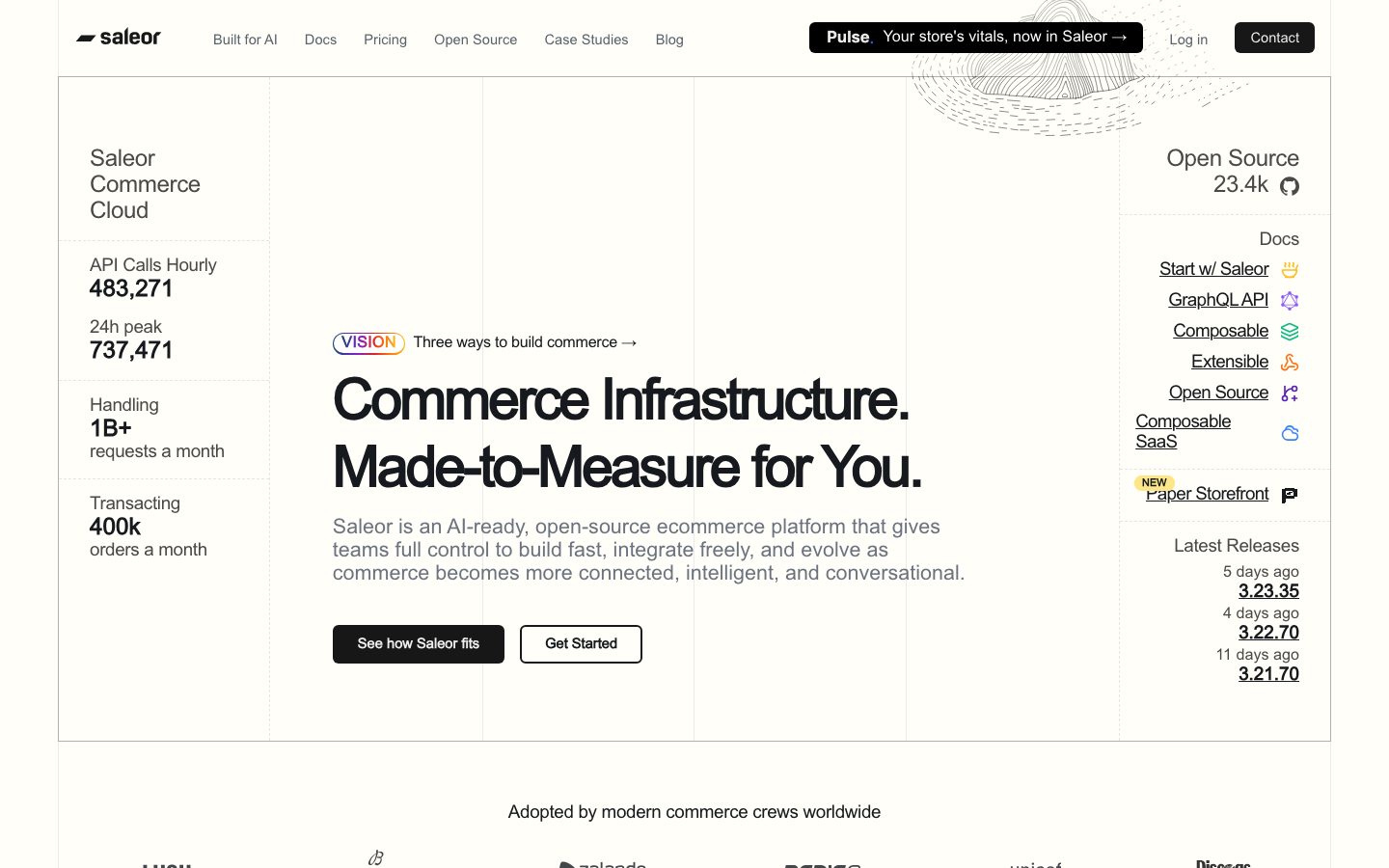
Saleor is a headless commerce platform with a GraphQL API as the primary interface. The backend is written in Python on Django, which matters to teams whose existing services and hiring are in that ecosystem.
The product covers the commerce domain: catalogue with variants and attributes, checkout and orders, payments through a plugin interface, warehouses and stock, and multi-channel selling where one catalogue serves several storefronts with different currencies and pricing. The dashboard is a separate application that consumes the same API.
Compared with a hosted commerce product, Saleor leaves hosting and the storefront to the team, though a cloud offering exists. It suits organisations that want a GraphQL commerce backend they can extend in Python and operate themselves; it is a heavier starting point for a small store that only needs a working checkout.
Overview
Saleor's interface decision is that the API is GraphQL-first, and its implementation decision is that the backend is Python.
The commerce domain is modelled as a GraphQL schema: products with attributes and variants, channels, warehouses, checkout, orders, and payments. A storefront queries exactly the fields it needs, which suits composed frontends where a page pulls from several services. The dashboard is a separate client of the same API rather than a privileged back office.
Multi-channel selling is a first-class concept. One catalogue can be exposed through several channels with their own currency, pricing, and availability, which covers a brand selling through its own store and a marketplace from the same backend.
Payments and other extensions attach through a plugin interface, and the project can be self-hosted or run on the vendor's cloud. The tradeoff compared with a hosted product is that the storefront and the deployment are the team's work, which makes Saleor a heavier starting point for a small store.
Key Features
- GraphQL-first API
The commerce domain is exposed as a GraphQL schema, so a storefront queries exactly the fields it needs.
- Multi-channel selling
One catalogue serves several channels with their own currency, pricing, and availability.
- Payment plugins
Payment providers attach through a plugin interface, so a market can be served by a local provider.
- Python and Django
The backend is Python, which matters to teams whose services and hiring are already in that ecosystem.
Where Saleor is a strong choice, and where it is not
Choose Saleor when the team works in Python, wants a GraphQL commerce backend, and needs multi-channel selling from one catalogue.
Look elsewhere if the priority is the shortest path to a working storefront. Saleor is a backend, so the frontend, hosting, and operations remain the team's responsibility.
Getting started
The backend runs quickly; the storefront is a separate project.
- ~30 minTime to running backend
Deploy the stack or use the cloud offering, and the GraphQL API is available.
- FreeCost to start
Self-hosted and free. A paid cloud offering exists.
- Python + PostgresPrerequisites
Docker or a Python environment plus Postgres. A storefront is built separately.
Known limitations
Constraints confirmed from the project's documentation.
- No storefront included. It is headless, so the frontend is a separate build.
- You operate the deployment. The database and services are yours unless you use the cloud offering.
- GraphQL has a learning curve. The API is powerful and not something you can guess at.
- Smaller ecosystem than hosted platforms. Fewer ready-made integrations and themes.
Pick Saleor when the team works in Python
It is a GraphQL-first commerce backend written in Python on Django, which matters if your services and hiring are already there.
Multi-channel selling lets one catalogue serve several storefronts with their own currency and pricing, which covers selling through more than one surface.
If the priority is the shortest path to a working storefront, a hosted platform makes decisions that Saleor leaves to you.
FAQ
What is Saleor?
Saleor is an open-source headless commerce platform with a GraphQL API, written in Python on Django.
Is Saleor free?
The core is open source and free to self-host. A paid cloud offering is also available.
Why GraphQL?
A GraphQL schema lets a storefront request exactly the fields it needs, which suits composed frontends pulling from several services.
Does Saleor support multiple storefronts?
Yes. Multi-channel selling lets one catalogue serve several channels with their own currency and pricing.
What stack is Saleor built with?
CompassPad records Saleor as a Python and Django backend with PostgreSQL, based on its public repository.
What we checked
- LIVESite and primary link
The marketing site resolved and the primary product link reached the application.
- PRICINGPricing page
The pricing page resolved and lists a free open-source edition alongside a paid cloud offering.
- DOCSDocumentation
Documentation is public and covers the architecture, GraphQL API, channels, and payments.
- FRESHNESSChangelog
A dated public blog publishes releases and is reachable without an account.
Discussion
No comments yet. Be the first.
Join the conversation. Sign up to comment.
Sign up free