

Sourcegraph
Screenshots
 1 / 2
1 / 2The Story
Sourcegraph is a code search and intelligence platform for organisations with many repositories. It indexes source across a codebase so a query can find a symbol, a pattern, or a usage across repositories that would otherwise be searched one at a time.
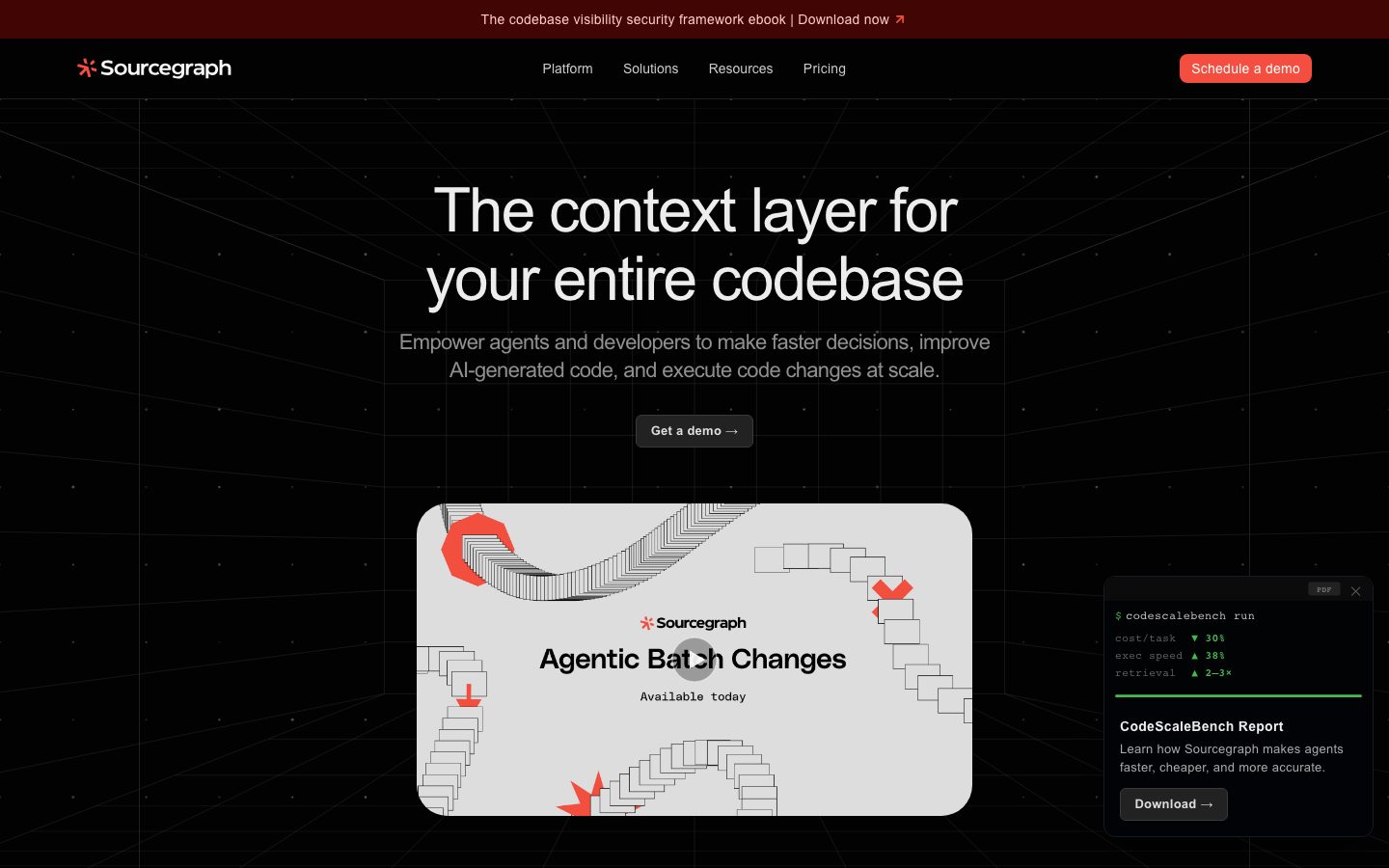
Beyond search, the platform provides code intelligence: go-to-definition and find-references that work across repository boundaries, which matters when a shared library is consumed by many services. Batch changes apply a scripted edit across many repositories and track the resulting pull requests, which is how a large-scale refactor is coordinated.
The product is open source in its core and available as a self-hosted or cloud deployment. It is aimed at organisations large enough that code is spread across many repositories; a small team with a handful of repositories will find a local search tool sufficient and the indexing overhead unjustified.
Overview
Sourcegraph indexes source across repositories so a question can be answered once rather than repository by repository.
A query searches indexed source across every connected repository. Symbols, patterns, and regular expressions are all searchable, and results are grouped so a usage that appears in forty services is visible in one view. For an organisation where a library is consumed widely, that replaces a sequence of local searches with a single question.
Code intelligence extends the index to navigation. Go-to-definition and find-references resolve across repository boundaries, so a change to a shared interface can be traced to every consumer before it is made. Batch changes apply a scripted edit across many repositories and track the pull requests that result, which is how a large refactor is coordinated rather than performed by hand.
The platform is open source in its core and can be self-hosted or run as a cloud service. The value scales with repository count: a small team with a few repositories will find local tooling sufficient and the indexing overhead hard to justify.
Key Features
- Cross-repository search
One query searches indexed source across every connected repository, grouping results by repository.
- Cross-repository navigation
Go-to-definition and find-references resolve across repository boundaries, so consumers of a shared interface are visible.
- Batch changes
A scripted edit is applied across many repositories with the resulting pull requests tracked in one place.
- Self-hostable core
The core platform is open source and can run on your own infrastructure where source cannot leave the network.
Where Sourcegraph is a strong choice, and where it is not
Choose Sourcegraph when source is spread across many repositories and answering a question currently means searching them one at a time.
Look elsewhere if the organisation has a handful of repositories, or if the need is only a local editor search. The indexing and operational overhead is aimed at larger codebases.
Getting started
Indexing a large codebase takes time; the payoff is immediate once it is searchable.
- Hours to indexTime to first search
Connect repositories and wait for indexing. Search works across all of them once complete.
- FreeCost to start
A free tier exists alongside per-seat enterprise plans. The core is open source.
- Many reposPrerequisites
Access to the repositories to index, and somewhere to run the service for self-hosting.
Known limitations
Constraints confirmed from the project's documentation.
- Value scales with repository count. With a handful of repositories, local tooling is sufficient and the indexing overhead is hard to justify.
- Self-hosting is a substantial service. Indexing infrastructure and storage are real operational work.
- Index freshness lags. Newly pushed code takes time to become searchable.
- Enterprise pricing. The per-seat model is aimed at organisations rather than individuals.
Pick Sourcegraph when code is spread across many repositories
It treats the whole codebase as one searchable corpus, which replaces a sequence of per-repository searches.
Cross-repository navigation is the deeper capability: tracing every consumer of a shared interface before changing it.
If the organisation has a few repositories, or the need is only local editor search, the overhead is not justified.
FAQ
What is Sourcegraph?
Sourcegraph is a code search and intelligence platform that indexes source across many repositories for searching and navigation.
Is Sourcegraph free?
Sourcegraph lists a free tier alongside per-seat enterprise plans, and the core platform is open source.
Can it search across repositories?
Yes. One query searches every connected repository and groups results by repository.
What are batch changes?
A batch change applies a scripted edit across many repositories and tracks the resulting pull requests in one place.
What stack is Sourcegraph built with?
CompassPad records Sourcegraph as a Go backend with a TypeScript and React frontend, based on its public repository.
What we checked
- LIVESite and primary link
The marketing site resolved and the primary product link reached the application.
- PRICINGPricing page
The pricing page resolved and lists a free tier alongside per-seat enterprise plans.
- DOCSDocumentation
Documentation is public and covers code search, code intelligence, and batch changes.
- FRESHNESSChangelog
A dated public blog publishes releases and is reachable without an account.
Discussion
No comments yet. Be the first.
Join the conversation. Sign up to comment.
Sign up free