Back to Discover
S

SimpleTax

StartupLaunched September 2026

Screenshots

The Story

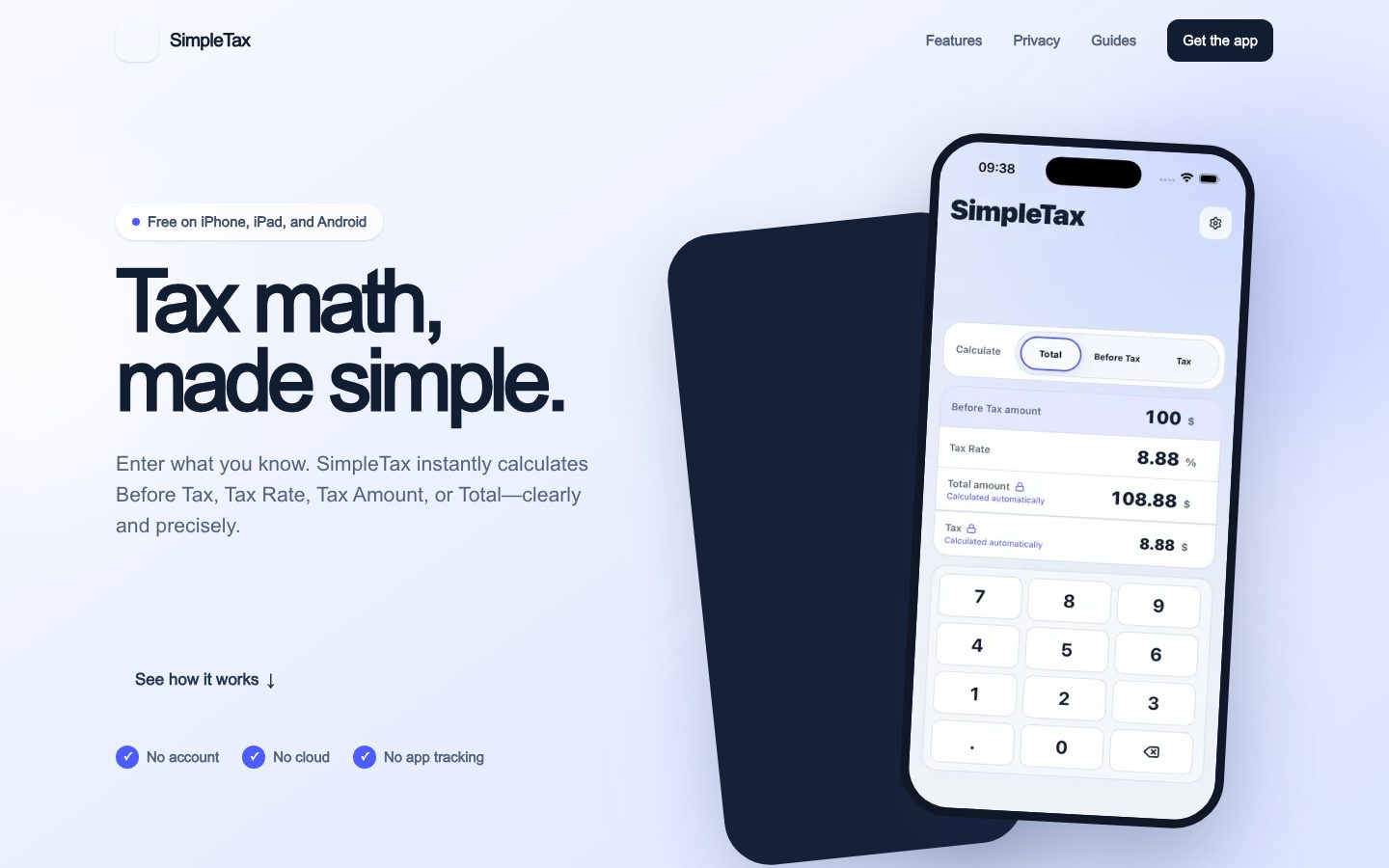
SimpleTax is a small calculator for tax arithmetic. Its page describes it as free to download for iPhone, iPad, and Android, and states that it calculates before-tax, tax rate, tax amount, or total, entirely on the device.

The site emphasises that the calculation works from whichever number you start with, uses currency-aware rounding, and keeps data local rather than sending it to a server. It is a single-purpose utility rather than a filing or accounting product: the page describes arithmetic, not returns or bookkeeping.

FAQ

What is SimpleTax?

Tax math, made simple.

Where can I access SimpleTax?

Use the official product link below. It is the destination recorded for this listing.

Where should I check current pricing and availability?

Check the current product page before making a decision. The directory's pricing category is a listing field, not a live price quote or availability guarantee.

What stack is SimpleTax built with?

The CompassPad entry does not list a specific stack for SimpleTax.

Is SimpleTax free, or does it cost money?

The CompassPad listing does not confirm a pricing model for SimpleTax. Check the product page for current details.

Discussion

No comments yet. Be the first.

Join the conversation. Sign up to comment.

Sign up free

Similar But Scrappier

Ride Markets

Trending

Fund your calls on Solana tokens.

FinanceCCompassPad editorial

Ride Markets lets someone call a token on Solana and have funds back that call with real capital. Its page describes the arrangement as: call any token, funds back you, and you keep your share of the profit. The product is a markets and trading tool rather than a wallet or exchange. Its public page describes the mechanism in one line and does not publish a fee schedule or documentation at the time of collection.

Stripe

FeaturedTrending

Payments infrastructure with the widest set of payment methods and billing primitives.

Developer ToolsCCompassPad editorial

Stripe is a payments platform that handles card and alternative payment methods, subscriptions, invoicing, and the money movement around them. A developer integrates through an API and hosted or embedded components, and the platform absorbs the network of acquiring banks, card networks, and local payment methods behind that interface. The breadth is the reason it is the default choice for online businesses. Beyond accepting a payment, the platform covers subscription billing with proration and trials, usage-based metering, invoicing, tax calculation, fraud screening, and payouts to connected accounts. Each of those is a product in its own right that a team would otherwise build or buy separately. The tradeoff is cost and control. Pricing is per transaction and adds up at scale, which is why larger businesses negotiate rates or move some volume to a direct acquirer. The platform is also opinionated about the merchant of record and the payout model, so businesses with unusual money-flow requirements sometimes find the constraints binding.

Shopify

Featured

Hosted ecommerce with checkout, payments, and an app ecosystem.

EcommerceCCompassPad editorial

Shopify is a hosted ecommerce platform. A merchant gets a storefront, a checkout, payment processing, inventory, and order management without operating any of it, and the platform handles the security and compliance work that accepting card payments requires. The product's scale comes from its app ecosystem. Anything the platform does not do natively — a loyalty programme, a subscription option, a review system, a warehouse integration — is available as an app, which means the platform can be extended without the merchant writing code. Themes control the storefront, and a headless mode exposes the commerce APIs for a custom frontend. The tradeoff is cost at scale and the constraint of a hosted model. Transaction fees apply when a third-party payment provider is used, app subscriptions add up, and the checkout cannot be fully customised outside the platform's extension points. Merchants with unusual requirements sometimes move to a headless platform to get that control back.