

Screenshots
The Story
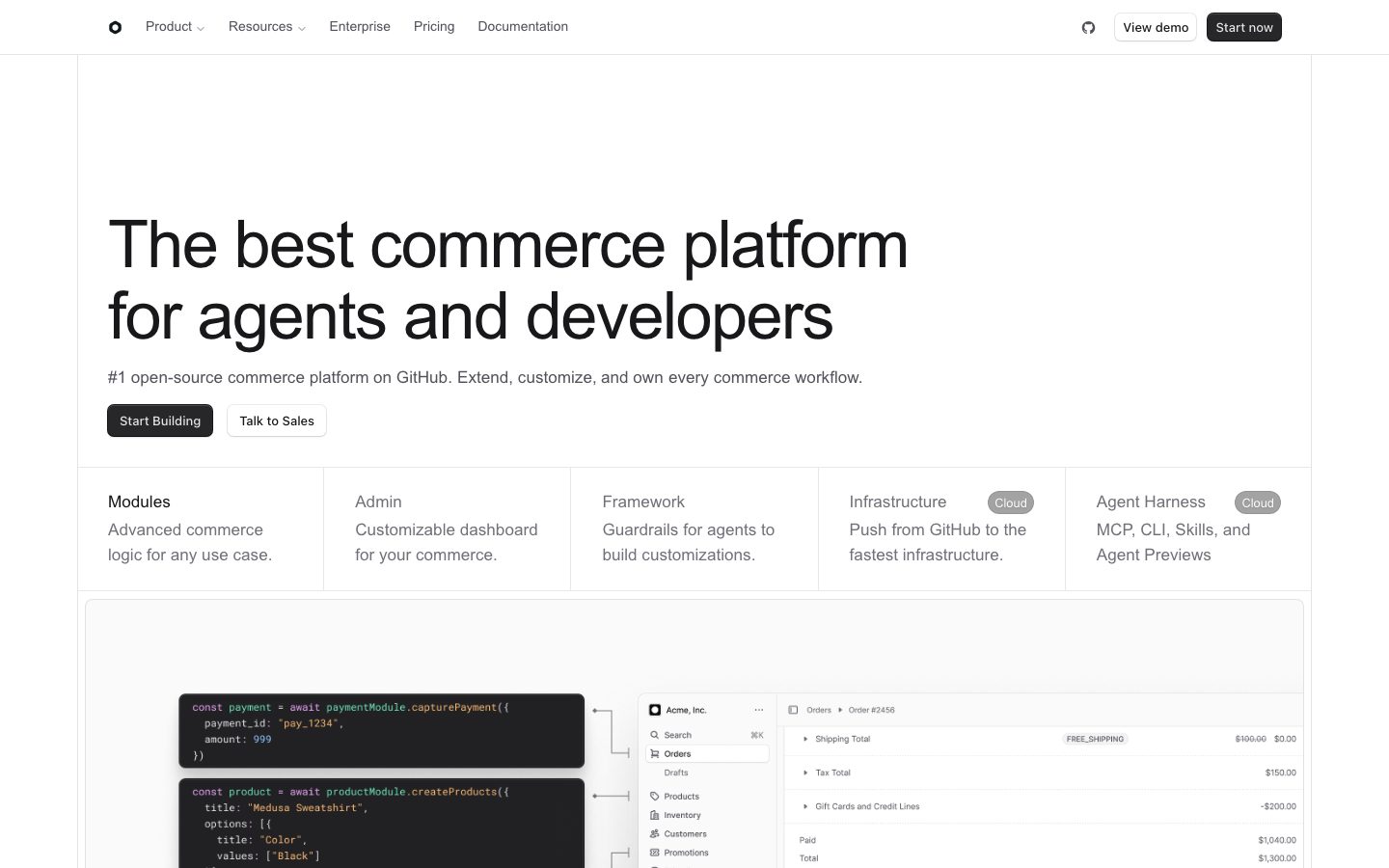
Medusa is an open-source commerce backend for teams building a storefront that does not fit a hosted platform's model. The core is a modular Node.js server that exposes commerce primitives - products, carts, orders, customers, regions - through an API.
The architecture is the differentiator. Commerce capabilities are modules with defined boundaries, so a team can replace the default implementation of one area without forking the whole system. A custom pricing module or a custom fulfillment integration plugs into the same interfaces the defaults use.
Medusa is headless: it provides the backend and the API, and the storefront is a separate application. The project publishes a starter storefront alongside the server, but the server does not assume a particular front end. That separation is what lets a team use it with a custom storefront, a mobile app, or a marketplace model.
Overview
Medusa separates the commerce backend from the storefront, and separates the backend into modules.
The server exposes commerce primitives through an API: products and variants, carts, orders, customers, regions, and pricing. A storefront consumes that API and owns its own presentation layer.
Capabilities are organized as modules with defined interfaces. A team that needs different pricing logic or a different fulfillment integration can replace that module rather than patching the core.
Because the platform is headless, the front end is a separate decision. The project publishes a starter storefront, but the backend does not require it, which is what makes a custom storefront or a marketplace model feasible.
Key Features
- Modular backend
Commerce capabilities are modules with interfaces, so one can be replaced without forking the platform.
- Headless by default
The backend serves an API and does not assume a particular storefront.
- Commerce primitives
Products, carts, orders, customers, regions, and pricing are provided as first-class records.
- Open-source core
The source is published in a public repository with a license file.
Where Medusa is a strong choice, and where it is not
Choose Medusa if a hosted commerce platform's model does not fit your catalog, pricing, or fulfillment, and you want to own the backend and the storefront separately.
Look elsewhere if you want a hosted storefront with a theme and a checkout out of the box, or if you do not want to operate a commerce backend.
Getting started
The backend starts quickly; building a storefront against it is the real project.
- ~20 minTime to running backend
Scaffold a project and the commerce APIs and admin panel start locally.
- FreeCost to start
Self-hosted and free. A paid cloud offering exists for teams that do not want to run it.
- Node + PostgresPrerequisites
Node.js and a Postgres database. A storefront is built separately.
Known limitations
Constraints confirmed from the project's documentation.
- No storefront included. It is headless, so the frontend is a separate project and a separate decision.
- You operate the deployment. The database, the backend, and the storefront are all yours to run.
- Upgrades need attention. Because customisation is code, a major version change requires reviewing your modules.
- Smaller ecosystem than the hosted platforms. Fewer ready-made integrations and themes.
Pick Medusa if your commerce logic does not fit a hosted platform
It is the option when the requirements are unusual enough that configuration keeps hitting a wall.
The premise is that commerce backends should be extended in code, which is the shortest path for bespoke pricing or fulfilment.
If the goal is to launch a standard store quickly, a hosted platform makes the decisions Medusa leaves to you.
FAQ
What is Medusa?
Medusa is an open-source headless commerce backend that exposes commerce primitives through an API for a separate storefront.
Is Medusa open source?
Yes. The source is published in a public repository with a license file. Check the repository for current license terms.
Does Medusa include a storefront?
The project publishes a starter storefront, but the backend is headless and does not require a particular front end.
Is Medusa free?
Medusa is open source and lists a paid cloud offering. Check the pricing page for current terms.
What stack is Medusa built with?
CompassPad records Medusa as a TypeScript and Node.js server on PostgreSQL with Redis, based on the public repository.
What we checked
- LIVESite and primary link
The marketing site resolved and the primary product link reached the product itself.
- PRICINGPricing page
The pricing page resolved and lists the current plans and limits.
- DOCSDocumentation
Public documentation resolved and covers the product's core surfaces.
- SOURCESource page
The linked source page resolved and is reachable without an account.
Discussion
No comments yet. Be the first.
Join the conversation. Sign up to comment.
Sign up free