

Coursera
Screenshots
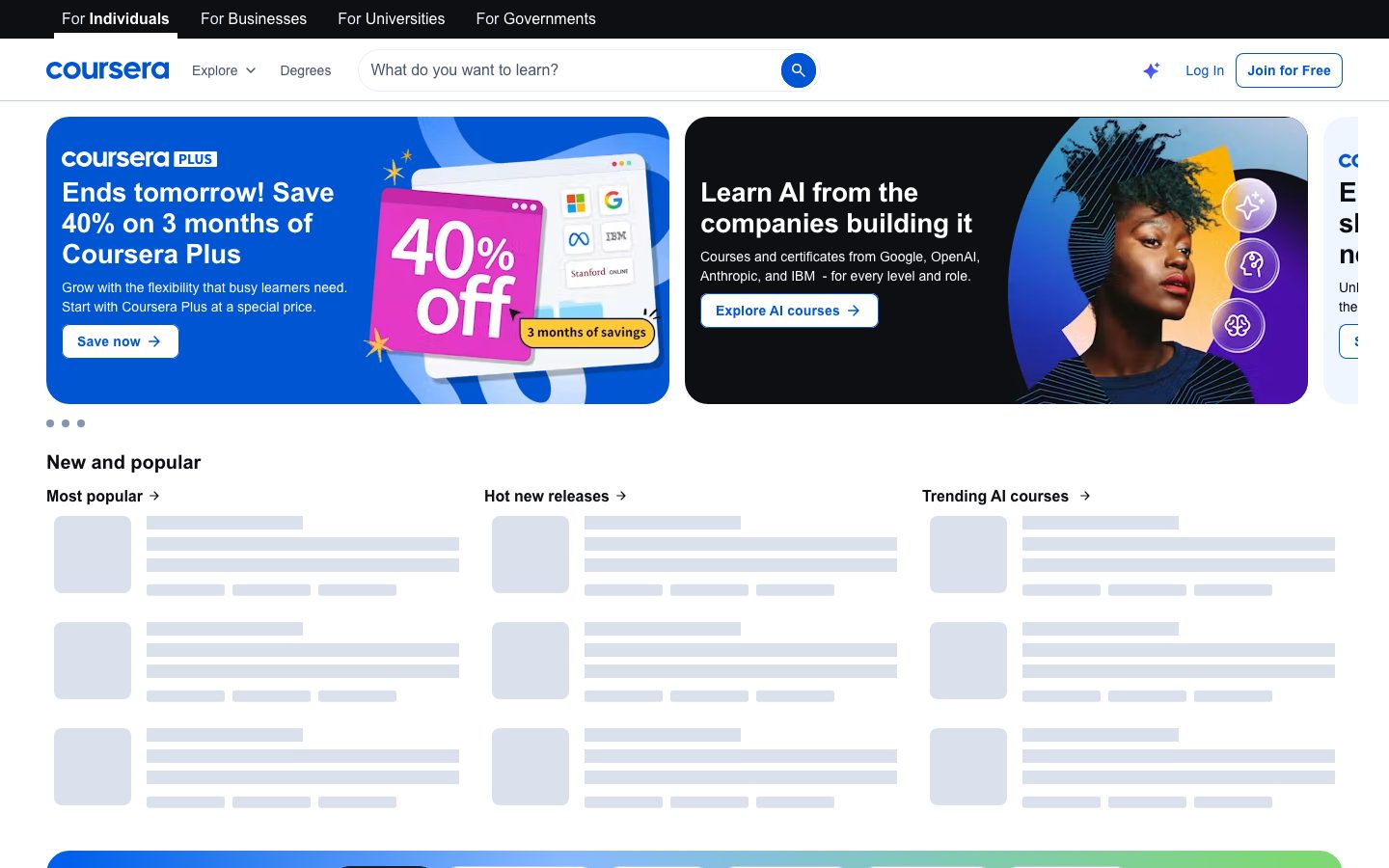
The Story
Coursera is an online learning platform that hosts courses from universities and companies. A course is a sequence of video lectures, readings, and graded assessments, and completion produces a certificate that can be verified through a public URL.
The platform's distinguishing feature is the credential. Courses come from named institutions, and several are assembled into specialisations or professional certificates that represent a longer commitment. Graded work is submitted and evaluated, which is what separates the platform from a video library.
The tradeoff is the format. A recorded course cannot adapt to a learner the way a tutor or a cohort programme can, and the completion rates for self-paced online courses are low across the category. The platform also sells degrees, which are a different commitment and price point from the individual courses.
Overview
Coursera's differentiator within online learning is that the courses carry institutional names and produce a verifiable certificate.
A course is a structured sequence: video lectures, readings, and assessments. Some assessments are auto-graded quizzes, others are peer-reviewed assignments. Completing the sequence produces a certificate with a public verification URL, which is what allows the work to be cited on a CV or a professional profile.
Courses assemble into larger units. A specialisation groups several related courses around a topic, and a professional certificate is designed with an employer's input to map onto a job role. Those longer programmes are where the platform's completion rates are highest, because the commitment is explicit.
The format has inherent limits. A recorded course cannot adapt to an individual learner the way a tutor or a live cohort can, and self-paced completion rates across the category are low. The platform also sells full degrees, which are a different commitment and price point from an individual course.
Key Features
- Institution-backed courses
Courses are produced with named universities and companies, which is the source of the credential's weight.
- Graded assessments
Quizzes and peer-reviewed assignments are part of a course, which separates it from a video library.
- Multi-course programmes
Specialisations and professional certificates group courses around a topic or a job role.
- Verifiable certificates
Completion produces a certificate with a public verification URL that can be cited on a profile.
Where Coursera is a strong choice, and where it is not
Choose Coursera when a credential from a named institution matters, or when a structured programme with graded work suits how you learn.
Look elsewhere if you want adaptive instruction, live feedback, or a cohort to learn with. A recorded course is a fixed sequence and cannot adjust to the individual.
Getting started
Enrolment takes minutes; finishing a course is the commitment.
- ~5 minTime to first lesson
Find a course and start. Many can be audited without payment.
- Free auditCost to start
Auditing is free. Graded work, certificates, and programmes require payment.
- NothingPrerequisites
An account. Payment only for graded work and certificates.
Known limitations
Constraints confirmed from the platform's documentation.
- Recorded courses cannot adapt. A fixed sequence does not respond to what a learner is struggling with.
- Completion rates are low across the category. Self-paced courses depend on self-discipline.
- Certificates are not degrees. Recognition depends on the employer, and the credential is not accredited in most cases.
- Audit access is limited. Graded assignments and certificates are behind payment.
Pick Coursera when the credential matters
Courses carry named institutions and produce a verifiable certificate, which is the differentiator within online learning.
The value is the structured programme with graded work and a partner institution behind it.
If you want adaptive instruction, live feedback, or a cohort to learn with, a recorded course cannot provide that.
FAQ
What is Coursera?
Coursera is an online learning platform hosting courses from universities and companies, with graded assessments and certificates.
Is Coursera free?
Many courses can be audited for free, while graded work, certificates, and programmes require payment.
Are Coursera certificates recognised?
Certificates are issued with the partner institution and can be verified through a public URL, though recognition depends on the employer.
What is a specialisation?
A specialisation groups several related courses around a topic, usually with a capstone project.
What stack is Coursera built with?
CompassPad records Coursera as a React and TypeScript frontend with a Python and Scala backend, based on public engineering writing and job listings.
What we checked
- LIVESite and primary link
The marketing site resolved and the primary product link reached the application.
- PRICINGPricing page
The pricing page resolved and lists free audit access alongside paid course and subscription plans.
- DOCSDocumentation
Help documentation is public and covers enrolment, assessments, and certificates.
- FRESHNESSChangelog
A dated public blog publishes updates and is reachable without an account.
Discussion
No comments yet. Be the first.
Join the conversation. Sign up to comment.
Sign up free

