

Screenshots
 1 / 2
1 / 2The Story
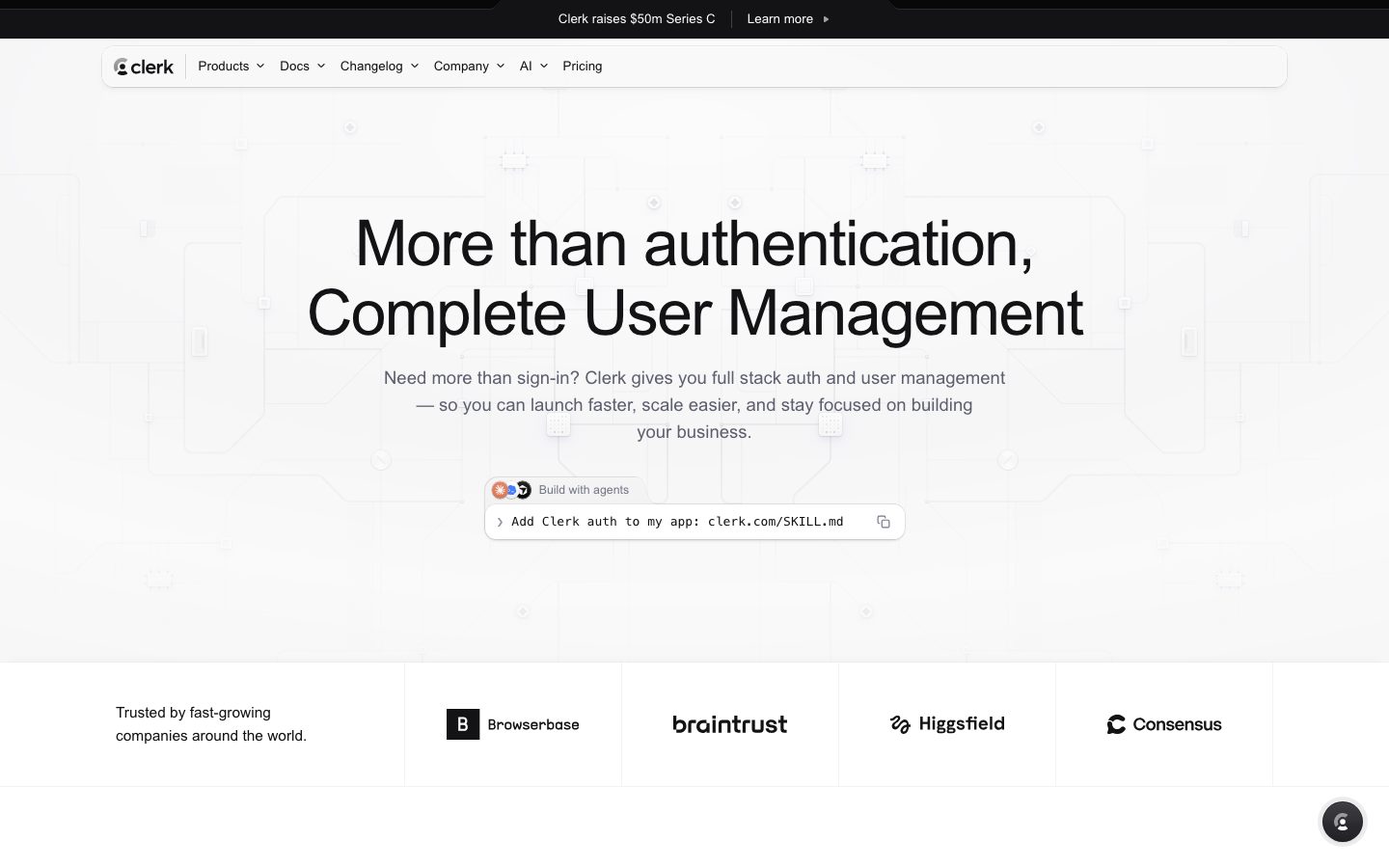
Clerk is an authentication service that ships prebuilt user interface components alongside the underlying session infrastructure. The pitch is that sign-in, sign-up, profile management, and organization switching should not be a multi-week build for every application.
The integration is a set of components rather than a form the developer assembles. A React application mounts a provider, and the sign-in and user-profile surfaces render with the application's styling. Underneath, Clerk manages sessions, password hashing, multi-factor flows, and social providers.
Beyond basic authentication, Clerk models organizations: a user can belong to several organizations with different roles, and the session carries the active organization so application code can authorize against it. The service publishes documentation, a changelog, and a status page, and the SDKs are open source even though the service itself is not.
Overview
Clerk's bet is that the user-facing half of authentication is where most of the work lives.
An application mounts a provider at the root and renders Clerk's sign-in and sign-up components. Those components handle the flows - password, email code, social provider, multi-factor - and report a session back to the application.
The user profile surface is also a component. It covers display name, email addresses, connected accounts, active sessions, and security settings, so an application does not build a settings page from scratch.
Organizations are modeled as a first-class concept. A user can belong to several organizations with distinct roles, and the session records which organization is active. Application code reads that from the session rather than maintaining its own membership table, which is the main reason teams choose Clerk over a bare authentication library.
Key Features
- Prebuilt UI components
Sign-in, sign-up, and user profile render as styled components rather than forms the developer assembles.
- Organizations and roles
Membership and role live in the session, so authorization reads from one place.
- Multi-factor flows
Additional verification factors are configured rather than implemented.
- Open-source SDKs
The client libraries are published in public repositories even though the service is hosted.
Where Clerk is a strong choice, and where it is not
Choose Clerk if authentication is not your differentiator and you want the user-facing surfaces - sign-in, profile, organization switching - to arrive finished.
Look elsewhere if you need to own the credential store outright, or if your authentication requirements are unusual enough that a component-based flow does not fit.
Getting started
Authentication is working within an afternoon; the design work is deciding what your user model should be.
- ~30 minTime to first sign-in
Install the SDK, add the provider, and the prebuilt components render a working sign-in flow.
- FreeCost to start
The free tier covers a monthly active user allowance. Paid plans scale with usage.
- NothingPrerequisites
An account and an application to embed the components in.
Known limitations
Constraints confirmed from the public documentation.
- Pricing scales with monthly active users. Cost is tied to usage rather than seats, which is predictable for a small app and material at consumer scale.
- Vendor-hosted user data. Profiles live with Clerk. Teams with data residency requirements need to check the region and compliance options first.
- Prebuilt UI is opinionated. The components are fast to adopt and require work to make fully bespoke.
- Migration means exporting users. Moving to another provider requires exporting password hashes or forcing a reset, so it is a planned project rather than a config change.
Pick Clerk when authentication is not the product
It removes a category of work that is easy to underestimate: sessions, password reset, MFA, social providers, and the edge cases around all of them.
Building authentication correctly takes longer than teams expect, and the failure modes are security incidents. Clerk's value is that the prebuilt flows handle the parts that are easy to get wrong.
The cost is dependency. User records live with the vendor and pricing follows usage. A team that expects to own the identity layer long-term should weigh that against the time saved.
FAQ
What is Clerk?
Clerk is an authentication and user management service that provides prebuilt sign-in, sign-up, and profile components alongside session infrastructure.
Does Clerk support organizations?
Yes. Users can belong to multiple organizations with distinct roles, and the active organization is recorded in the session.
Is Clerk free?
Clerk lists a free tier alongside paid plans based on monthly active users. Check the pricing page for current limits.
Are Clerk's SDKs open source?
Yes. The client libraries are published in public repositories. The hosted service itself is proprietary.
What stack is Clerk built with?
CompassPad records Clerk as a TypeScript and React front end with a Go service layer, based on public engineering writing and job listings.
What we checked
- LIVESite and primary link
The marketing site resolved and the primary product link reached the product itself.
- PRICINGPricing page
The pricing page resolved and lists the current plans and limits.
- DOCSDocumentation
Public documentation resolved and covers the product's core surfaces.
- CHANGELOGChangelog page
The linked changelog page resolved and is reachable without an account.
Discussion
No comments yet. Be the first.
Join the conversation. Sign up to comment.
Sign up free